
Article
Planning a Family Move in Rose Bay: Schools, Space and Lifestyle
Thinking about a family move in Rose Bay? This guide helps you weigh school zones, lifestyle and borrowing capacity, so you can decide whether to stay, upsize or shift slightly out — and gives you a one‑week action plan to move from ideas to clear numbers.
Key Takeaway
This guide explains how Rose Bay families should balance school zones, lifestyle and borrowing capacity when planning a move. It highlights that housing costs above roughly 30–40% of net income can trigger financial stress, especially in premium suburbs, and outlines three main paths: renovate, upgrade locally, or shift to nearby suburbs. The article ends with a practical one-week checklist so households can become decision-ready, aligning property choices with schooling and lifestyle priorities.

Planning a Family Move in Rose Bay: Schools, Space and Lifestyle
When you’re planning a family move in Rose Bay, the decision should balance three things: the schools you can access, the lifestyle you actually live day‑to‑day, and what you can safely borrow without pushing your budget too far. In a high‑price, tightly held suburb, getting that balance wrong can mean either over‑stretching or needing to move again in a few years. This guide is designed to help you make a decision you’re comfortable with this week, not “one day”.
1. How to think about a Rose Bay family move
Rose Bay sits in that rare pocket of Sydney where beach, harbour and village life overlap. That also means every extra bedroom, school catchment or water glimpse tends to come with a big price tag.
If you’re weighing up a move, start with three framing questions:
-
What problem are we really trying to solve?
Is it school access, more bedrooms, better outdoor space, less commuting, or all of the above? -
How long does this next home need to work?
A 5‑year solution looks very different to a 15‑year “raise the kids here” home. -
What’s our true financial comfort zone?
Housing costs above roughly 30–40% of your net income are linked with higher financial stress, especially when all your wealth is in one expensive property.
In Rose Bay, the most common family crossroads are:
- Young family in an apartment wondering if they should buy a semi or house before school starts.
- Primary school family debating whether to stretch into a “forever” home now or wait.
- Teen-family considering a lifestyle shift (closer to school, less traffic, or different pace) while still staying in or near the Eastern Suburbs.
If you’re not yet clear on the type of property or sequence of moves, it’s worth pairing this guide with the broader strategy work in Practical First and Next‑Home Strategies for Rose Bay Buyers.
2. Schools in and around Rose Bay: what really matters
For most families, school is the anchor around which everything else turns. In Rose Bay, you have a mix of public, Catholic and independent schools within a short radius. Rather than chasing school names, focus on how education and property interact.
2.1 Catchments and enrolment zones
- Public school intake areas change. Boundaries for local public schools are reviewed from time to time by the NSW Department of Education. Always check the current school intake map before assuming a property is “in zone”.
- Similar streets can mean very different options. In Eastern Suburbs pockets, being on the wrong side of a single street can change which public school you’re entitled to.
- Proximity still matters in practice. Even within the right catchment, being closer can help with before/after‑school logistics and social life.
2.2 Private and Catholic schools
Independent and Catholic schools in and around Rose Bay are a major drawcard, but they come with:
- Fees and extras. You’re potentially trading mortgage repayments for school fees, or carrying both.
- Waitlists. Popular schools may expect applications years in advance. If your plan relies on a specific school, confirm the enrolment reality before you buy.
- Travel time. A “10‑minute drive” on a map can be 25 minutes door‑to‑door once you factor in traffic and parking near popular schools.
2.3 Commute patterns, not straight-line distance
For younger kids, walking or a short bus trip is often ideal. For older kids, access to reliable buses or trains might matter more than being within 500 metres. When assessing a property:
- Do a test run at school time from the front door to the school gate.
- Consider how many days you actually work from home vs commute.
- Think about who is doing drop‑offs most days and what that does to their workday.
A property that’s slightly smaller but within an easy walk of school, playgrounds and sport can work better than a bigger home that creates daily traffic battles.
3. Lifestyle trade‑offs: beach, harbour, commute and community
Rose Bay offers a rare blend: harbour walks, ferry wharf, nearby beaches and a village strip with cafes and essential services. But not every pocket offers the same feel.
3.1 Beach and harbour access
- Harbourfront pockets give you quick access to the promenade, parks and the ferry, but often at a steeper buy‑in price.
- Side‑street and hill locations can mean better value and quieter streets, at the cost of a slightly longer walk.
Ask yourself:
- Do we actually get to the beach/harbour several times a week, or mainly on weekends?
- Would we trade a 5‑minute walk for a 12‑minute walk if it meant an extra bedroom or study?
3.2 Commute and transport
- Ferry vs car vs bus. The ferry is a lifestyle feature, but it doesn’t work for every CBD job. If you rely on driving, factor in peak‑hour traffic on New South Head Road.
- Parking pressures. Some streets are heavily parked during school times and evenings. Inspect at different times of day.
3.3 Community, support and activities
If you have younger children, proximity to:
- daycare, kindy and early learning
- kids’ sport (Bondi, Lyne Park, Woollahra Ovals, etc.)
- grandparents or other support
can matter more than an extra 10 square metres of internal space.
Write down your top five weekly routines (for example, daycare drop‑off, swim squad, groceries, morning runs) and check how each potential move affects them.

4. Numbers first: what your next Rose Bay home can safely cost
Lifestyle and schools are only sustainable if the numbers work. After the rapid rate rises from 2022 onwards (RBA cash rate data), lenders are tighter and families feel repayment changes more quickly.
4.1 Understand your safe repayment range
Most banks and brokers will talk about maximum borrowing capacity. A more useful question is:
“At what monthly repayment level would we start losing sleep?”
As a rough guide:
- Aim to keep total housing costs (home loan, strata, rates, insurance) below 30–40% of net household income.
- Remember that lenders apply at least a 3 percentage point serviceability buffer above current rates (per APRA guidance). Make sure your own comfort test is just as tough.
Worked example
Say you’re considering a $2.8 million home with a $1.8 million loan over 30 years, principal and interest.
- At a 6.0% rate (illustrative only), repayments are about $10,790 per month.
- A 0.5 percentage point change in rate shifts that by around $200 per month and more than $70,000 in total interest over 30 years (see also our broker benefits analysis in another guide).
If your net household income is $28,000 per month, that’s about 39% of take‑home pay before adding strata, rates and school fees. For some, that’s manageable; for others, it’s too tight.
4.2 Equity, deposits and transaction costs
For a family upsizing in Rose Bay, the common pattern is:
- Sell an apartment or semi (say $2.2 million).
- Clear the existing loan (say $1.2 million).
- Use the remaining equity plus savings as a deposit on a $3.0–3.2 million home.
Don’t forget:
- Stamp duty on a $3.0 million purchase is substantial (well into six figures).
- Allow for selling costs (agent, marketing) and moving/renovation buffers.
That’s why many families blend sale proceeds, cash savings, and sometimes family assistance or business cash. If you’re coordinating personal, company and SMSF money, it’s worth reading Orchestrating Personal, Company and SMSF Loans for Big Purchases.
4.3 Pre‑approval that survives Rose Bay reality
In a fast local market, a weak pre‑approval can fall over once a real property and valuation hit the file. For Rose Bay buyers, that’s risky.
A robust pre‑approval should be:
- Fully credit assessed, with payslips or full tax returns reviewed.
- Based on conservative assumptions about rates and living expenses.
- Matched to the type of property you’re targeting (apartment vs house vs small block).
If you’re planning to bid at auction or move quickly on an off‑market opportunity, work through our detailed checklist in Designing Auction-Proof Home Loan Pre-Approval for Rose Bay Buyers.
5. Three common paths: renovate, upgrade, or shift slightly out
Most Rose Bay families considering a move end up choosing between three broad paths. There’s no right answer; it comes down to which trade‑offs you’re willing to make.
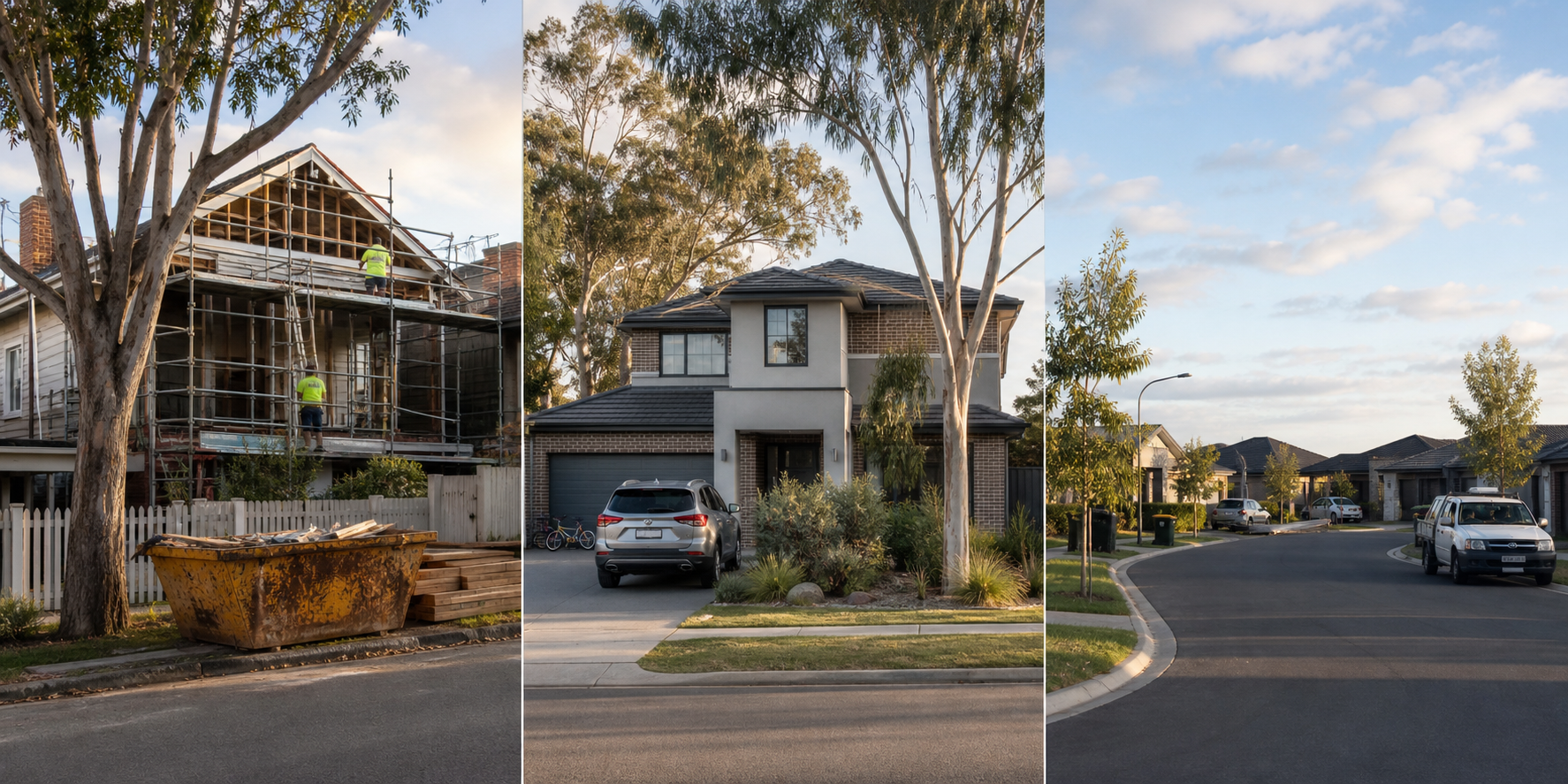
5.1 Option 1 – Stay put and renovate
You keep your current address and school access, and focus on making the existing property work harder (adding a bedroom, better storage, outdoor space or study).
Pros
- No change to school catchments or community.
- Lower transaction costs than selling and buying.
- You can stage works over time.
Cons
- Building costs and DA rules can be unpredictable.
- You’re still on the same block and street (noise, light, neighbours don’t change).
- Equity stays tied up; borrowing for renovations still needs to pass lender tests.
5.2 Option 2 – Upsize within Rose Bay
Here you aim for a bigger semi or freestanding home in Rose Bay itself.
Pros
- Maintain local networks, activities and familiar routines.
- Potential long‑term capital growth in a blue‑chip suburb.
- Kids can often stay in the same schools.
Cons
- Higher price point and bigger loan.
- You may need to compromise on yard size, parking or finishes.
- More exposure to property market swings in one high‑value asset.
5.3 Option 3 – Shift slightly out, keep lifestyle
This means moving to adjacent or nearby suburbs (for example, slightly further inland or to a different part of the Eastern Suburbs) while preserving most of your lifestyle.
Pros
- Often better value per square metre.
- More choice of houses with gardens or quieter streets.
- Can widen your school options while still being close to the harbour or beach.
Cons
- New routines and potentially new social circles.
- Different council rules, school zones and parking norms.
- More time in the car if you keep schools and activities back in Rose Bay.
5.4 Comparing the three paths
| Path | Typical goal | Cash impact (indicative)* | School impact | Lifestyle impact |
|---|---|---|---|---|
| Stay and renovate | Make current home work 5–10 yrs | Lower stamp duty; reno budget $150k–$600k | Usually unchanged | Same street; better layout, more storage |
| Upsize within Rose Bay | Long‑term family base | Higher purchase + stamp duty; bigger loan | Usually same schools, same catchment | Similar routines; extra space, maybe less walkability |
| Shift slightly out of suburb | More space / value | Similar or lower purchase; new costs vary | New zones and/or school choices | New community; may add to commute |
*Figures are broad ranges only, not advice. Construction and property costs move quickly.
When you map your own decision, put real numbers next to each path. You can use the one‑week checklist at the end of this guide to do that without it taking over your life.
6. Specific issues for self‑employed and business owners
For many Rose Bay households, income comes from a business, practice or consulting work. That can make both lending and lifestyle more complex.
6.1 Income and borrowing capacity
Self‑employed borrowers are assessed on tax returns, financials and sometimes BAS, not just what hits your bank account. Two key traps:
- Aggressively minimising taxable income before a loan application can backfire by reducing borrowing power more than the tax saved.
- Multiple recent credit applications (including business facilities) can weaken your profile and slow things down.
If that sounds familiar, have a look at Specialist finance support for self‑employed professionals in Sydney’s East and, if you’re a first‑time buyer, Buying Your First Home When You Run a Small Business.
6.2 Separating home, investment and business debt
It’s common for a family home in a premium suburb to be used as security for:
- the home loan itself
- an investment property loan
- a business overdraft or equipment facility
To protect your flexibility:
- Keep loan splits clearly separated by purpose (home vs investment vs business).
- Avoid cross‑collateralising everything against the home if you can.
- Revisit structures if your business grows or you take on new partners.
This becomes critical if you ever need to refinance, sell one property but keep another, or cleanly unwind business debt.
6.3 Time, energy and support
Running a business while moving house is a serious load. If you’re self‑employed and have school‑age kids, be realistic about:
- how much DIY renovation you’ll actually complete
- the impact of longer commutes on your working hours
- whether a slightly smaller but better‑located home might be the least disruptive option overall
Sometimes, the right answer is not the “biggest” move, but the one that preserves bandwidth for your business and family.
7. A one‑week action plan for your family
You don’t need to solve everything this week, but you can get from “vague ideas” to a grounded plan.
Day 1–2: Clarify your non‑negotiables
Sit down as a household and list your top priorities under three headings:
- Schools: must‑have vs nice‑to‑have (public/private, travel time, specific campuses).
- Lifestyle: walking distance to what? Harbour, beach, playground, cafes, ferry, bus.
- Home: bedrooms, study, outdoor space, parking, renovation appetite.
Force‑rank them. Something has to come first.
Day 3: Map your current and future routines
- Write out a typical weekday and weekend.
- Mark where each activity happens today (work, school, sport, grandparents, friends).
- Sketch how each of the three paths (renovate, upsize locally, shift slightly out) would change that map.
This quickly shows whether a move would genuinely improve your life or just change your mortgage.
Day 4–5: Get decision‑grade numbers
With your basic priorities clear, get some numbers that are specific to you:
- Estimate your safe repayment range. Work back from net income and comfort level, not just the bank maximum.
- Rough in your equity and deposit. Use realistic sale values, not dream prices.
- Talk to a broker or lender about a fully assessed pre‑approval and how the APRA buffer affects you.
If Rose Bay is definitely your target, combine this step with the planning work in Practical First and Next‑Home Strategies for Rose Bay Buyers.
Day 6: Shortlist concrete options
By now you should know:
- whether you lean towards renovating, upsizing in Rose Bay, or shifting slightly out
- the price range that sits within your comfort zone
- which school and lifestyle boxes are non‑negotiable
Use that to:
- shortlist 3–6 specific properties (including some “stretch” and some “safety” options), and/or
- request 1–2 renovation feasibility chats if you’re leaning towards building works.
Day 7: Decide your next quarter, not your next 20 years
You don’t have to commit to a purchase this week. But you can commit to a 90‑day plan, for example:
- “We’ll get full pre‑approval and attend 4–6 opens in Rose Bay and nearby suburbs.”
- “We’ll cost a renovation and compare it honestly to selling and buying.”
- “We’ll wait 12 months, but in that time we’ll clear X debt and save Y, so we’re ready when we move.”
Revisit your plan every quarter. In a suburb like Rose Bay, patience paired with clear numbers usually beats rushing into the wrong home.
8. FAQs about family moves in Rose Bay
Is it worth stretching to stay in Rose Bay for schools?
Sometimes, but not at any cost. If staying in Rose Bay pushes total housing costs well above 40% of net income and you’re also paying private school fees, you may feel constant pressure. Consider nearby suburbs that keep most of your lifestyle but give you more room in the budget.
How early should we think about school enrolments before buying?
Ideally, you should confirm school options before committing to a property. Check public school intake maps for your target address and speak directly with any independent or Catholic schools you’re considering about intake years, priority criteria and realistic timelines.
Should we buy first or sell first in Rose Bay?
It depends on your risk tolerance and how unique your current property is. Many families prefer to sell first so they know exactly what they can spend. Others with strong income and buffers may buy first, especially if pursuing off‑market opportunities, but this comes with more financing and timing risk.
What if we’re self‑employed and our income looks lumpy on paper?
Self‑employed income can be perfectly acceptable to lenders if it’s well‑documented and reasonably consistent over two or more years. You may need extra preparation time to finalise tax returns, clean up credit limits and present your business position clearly. A broker used to Eastern Suburbs professionals can help structure this.
Is renovating in Rose Bay always cheaper than moving?
Not always. Rising construction costs, heritage or planning constraints and the need to move out during major works can erode the savings. Renovating often makes most sense when you like your street and school options, and the main issues are layout or under‑used space rather than land size or aspect.
Key takeaways
- A good Rose Bay family move balances school access, lifestyle and a housing cost share that sits comfortably below 30–40% of net income.
- Small changes in school catchments or walking distance can have big effects on both property prices and daily routines.
- Map your three main paths — renovate, upsize locally, or shift slightly out — and put honest numbers and lifestyle impacts against each.
- Self‑employed families should plan extra time to prepare documents, structure debts clearly and avoid over‑committing the home to business loans.
- A one‑week sprint focusing on priorities, routines and numbers can move you from vague ideas to a 90‑day, decision‑ready plan.
If you’d like a calm, numbers‑first second opinion on your options, Ding Financial can help you test different scenarios, structure your loans and coordinate your home and business plans so your next move actually fits your life.
General advice only.
Frequently asked questions
Talk to a CPA-certified broker
Free consultation, plain-English advice tailored to your situation.