
Article
Orchestrating Personal, Company and SMSF Loans for Big Purchases
How to coordinate your personal, company and SMSF borrowing capacity so your next premium home or investment move works across tax, serviceability and risk – not just on paper, but with buffers that survive real‑world shocks.
Key Takeaway
This article explains how to coordinate personal, company and SMSF borrowing so an Australian buyer can safely fund premium property while preserving borrowing capacity and buffers. It outlines how lenders aggregate group debts, why SMSF limited recourse loans usually cap at around 60–70% LVR, and how personal guarantees pull business loans into home-loan assessments. The key actionable insight is to map all entity balance sheets with a broker and accountant before committing to any large purchase.
Coordinating personal, company and SMSF borrowing means planning all your loans as one ecosystem so you can buy premium property without blowing up your home borrowing power, business stability or retirement savings. In practice, that means deciding which entity buys which property, in what order, and how much each should borrow, before you sign a contract.
Done well, a coordinated plan lets you:
- Secure the home you actually want.
- Grow your business and investments sensibly.
- Keep enough cash and super intact to handle shocks.
This guide is written for time‑poor founders, professionals and investors who want decision‑grade clarity this week.
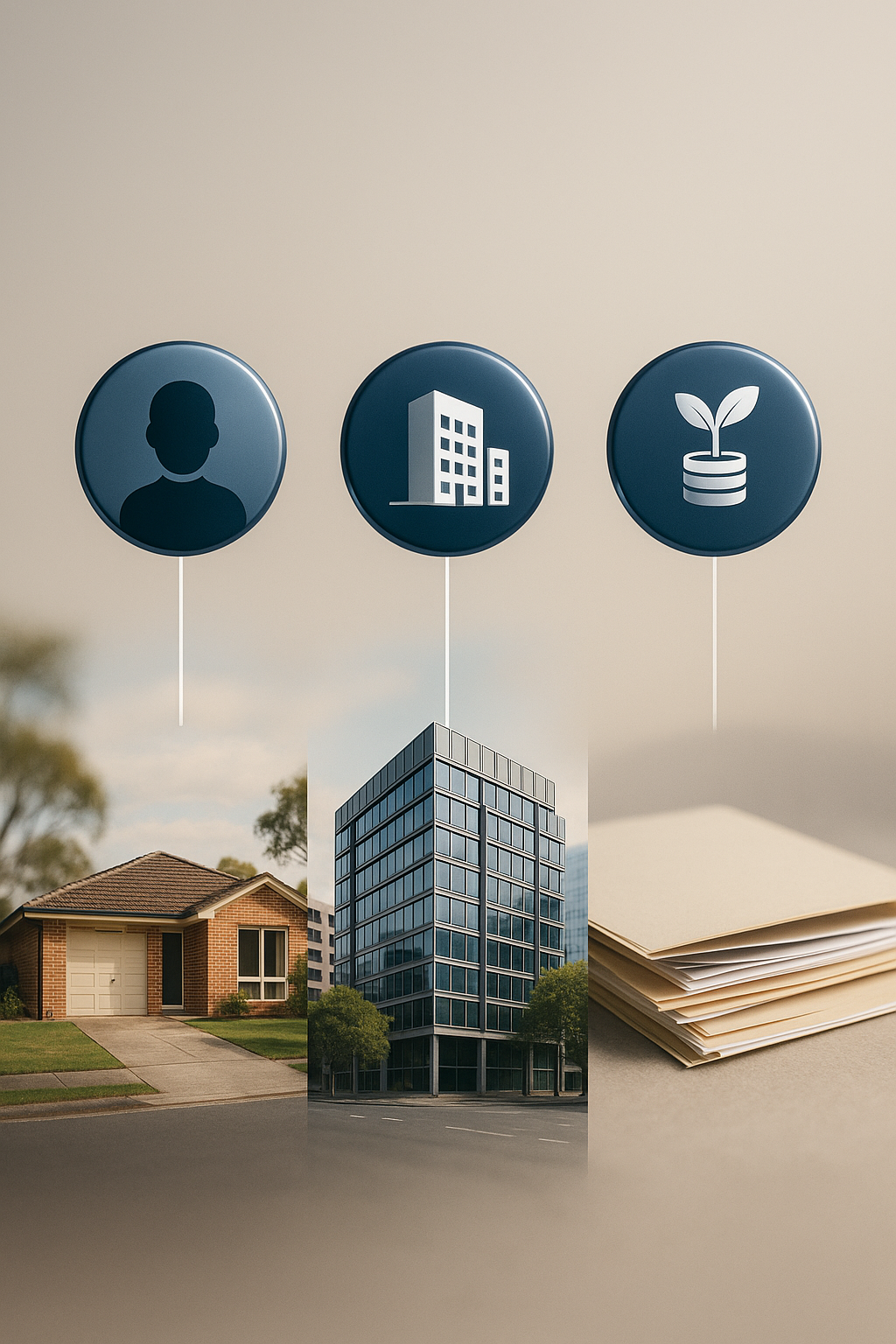
See your personal, company and SMSF loans as one connected ecosystem.
1. Start with the real goal: your premium property plan
A “premium property plan” isn’t just buying the most expensive home a bank will approve. It’s the mix of:
- Your main residence (often $1.5m–$5m+ in major cities).
- One or two quality investment properties.
- Possibly your own business premises (owned personally, via a company, trust or SMSF).
The mistake is treating each purchase as a one‑off. Lenders and regulators (APRA, ATO, ASIC) don’t see it that way. They look at:
- Your whole income story across entities.
- All debts you’ve guaranteed, even in the company.
- How leveraged your SMSF is and how concentrated its assets are.
The planning sequence that generally works best:
- Define the end state: what you’d like to own in 10–15 years (home + premises + investments).
- Rank priorities: usually home first, then business premises/investments, then SMSF property.
- Map borrowing buckets: personal, business/company, SMSF.
- Decide which bucket funds which asset and when.
If you only do one thing this week, sketch that end‑state picture and rough order on a single page. Everything else flows from there.
2. Your three borrowing buckets: features, limits and trade‑offs
2.1 Personal borrowing (home and investment loans)
Personal borrowing is usually your most flexible and cheapest source of property finance.
Key features:
- Security: usually your home or investment properties.
- LVRs: up to 80% without LMI, sometimes up to ~95% with LMI for homes (less for investments).
- Assessment: based on taxable income (salary, business profit, dividends) with a 3%+ APRA buffer on rates.
- Rates: generally lowest for owner‑occupied, principal & interest (P&I) loans.
Why this bucket matters most:
- It determines where you can live, and your kids’ school zones and lifestyle.
- Lenders weigh high‑impact personal debts (cards, personal loans, BNPL) heavily, often more than productive business loans.
- For self‑employed borrowers, aggressively minimising taxable income can hurt this bucket badly because lenders work off taxable profit.
If you’re self‑employed or a high‑income owner, read our deeper dive on home loans for high‑income self‑employed professionals and owners alongside this guide.
2.2 Company / business borrowing
Company or business borrowing (often via a company or trust) is typically used for:
- Business premises.
- Fit‑outs and equipment.
- Working capital and trade/invoice finance.
Key features:
- Security: the business premises and/or your home; often backed by director guarantees.
- Assessment: based on business cashflow and profit, plus your personal income and net worth.
- Rates & terms: depend on security quality, LVR, lease strength and business performance.
Critical issue: personal guarantees.
Most lenders treat business facilities you’ve personally guaranteed as personal commitments when assessing your home loan. Even when a vehicle loan or small equipment facility is in the business name, lenders often count the repayments in your personal serviceability.
For more on how business facilities and cards cut into your borrowing power, see Business Debts, Credit Cards and Car Loans: Protect Your Borrowing Power.
2.3 SMSF borrowing (property via LRBA)
SMSFs can borrow to buy property using a limited recourse borrowing arrangement (LRBA). These loans:
- Are limited recourse – the lender’s rights are limited mostly to the property held in a separate bare trust.
- Typically have lower maximum LVRs (often 60–70% for residential/commercial) and higher interest rates than standard home loans.
- Must meet strict rules about arm’s‑length rent and terms when leasing to related parties.
Because the LVR is lower, you often need a large existing balance plus ongoing contributions to make SMSF property viable.
And crucially, using your SMSF to buy property ties up a big chunk of your retirement savings in a single, illiquid asset, increasing concentration risk if it’s your only big SMSF holding.
For business owners considering putting premises in super, read Should Your SMSF Own Your Business Premises or Not? alongside this guide.
2.4 Comparing your three borrowing buckets
| Feature | Personal home/investment loan | Company / commercial loan | SMSF LRBA property loan |
|---|---|---|---|
| Typical max LVR (illustrative) | Up to 80–95% (home), 80–90% (investor) | ~60–80% depending on asset, lease, business | ~60–70% |
| Recourse | Full recourse to you (and guarantors) | Often to company + directors / cross‑collateral | Limited mainly to SMSF property |
| Rate level (indicative only) | Lowest for owner‑occupied P&I | Higher than home loans, lower than SMSF usually | Often highest of the three |
| Who’s assessed | You and co‑borrowers | Business + guarantors | SMSF cashflow, contributions and rent |
| Typical use | Home, residential investments | Business premises, fit‑outs, equipment, working capital | Business premises, long‑term investments |
All figures are indicative only – lenders and products vary, and no live rates are quoted.
The table makes one thing clear: personal borrowing is usually the cheapest and most flexible, SMSF borrowing is often the tightest and most expensive, and business borrowing sits in the middle.
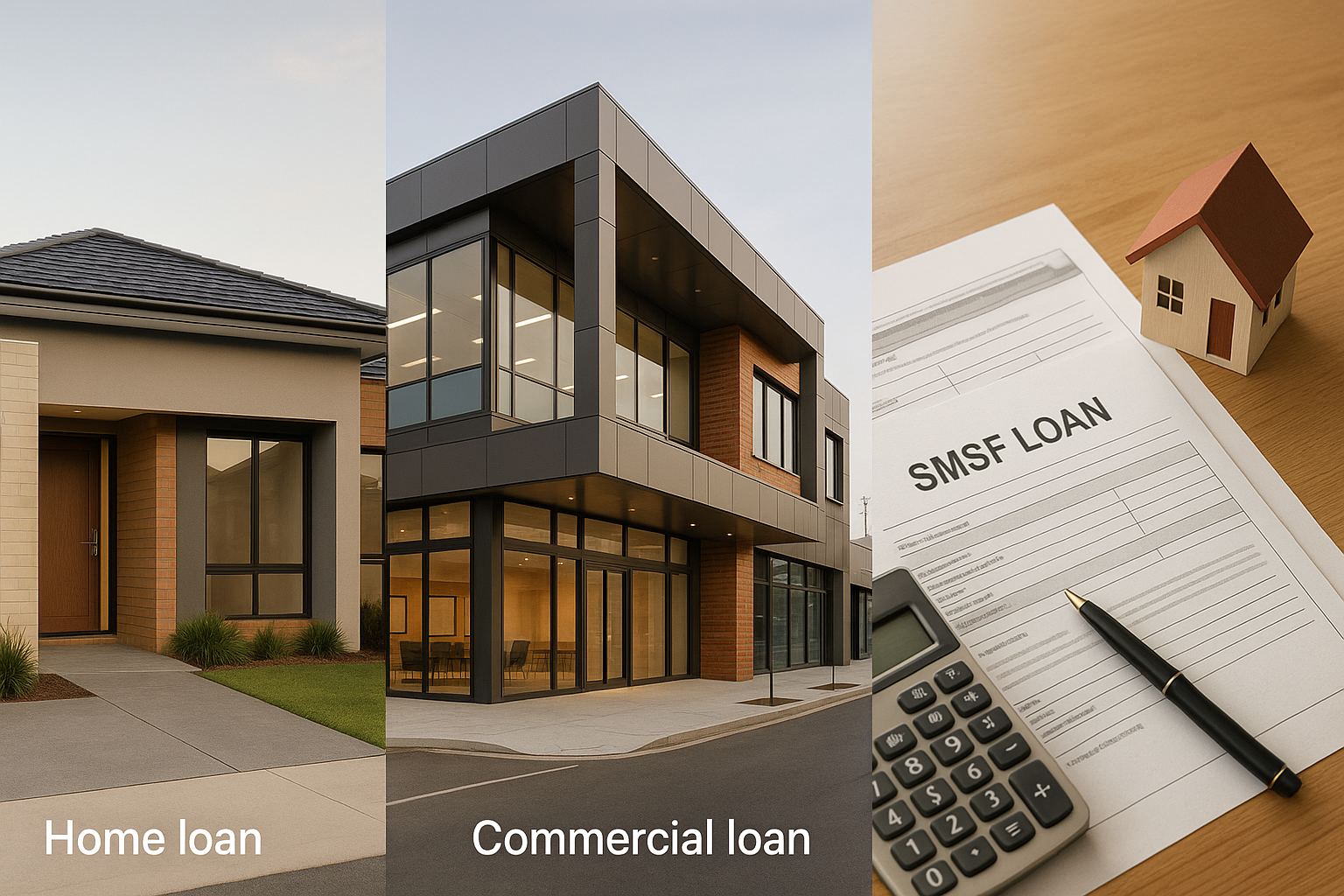
Each borrowing bucket has different LVRs, costs and limits you need to balance.
3. How lenders really see your group: one ecosystem, not three silos
On paper you might have “no personal debt” and think your company and SMSF loans sit neatly on their own. Lenders often see something quite different.
3.1 Personal guarantees drag business debt into home loan assessments
If you’ve personally guaranteed business loans, overdrafts, equipment finance or leases, most home loan lenders:
- Treat the full approved limits as potential exposure, not just the drawn amount.
- Add the monthly repayments into your personal serviceability calculation.
- May shade your income if large chunks are needed to keep the business afloat.
So that $500,000 business overdraft and $80,000 vehicle facility can quietly erase hundreds of thousands in home borrowing capacity.
3.2 Your income story must be consistent across entities
For self‑employed clients, banks look through the entire group:
- Company/trust profit and loss and balance sheets.
- Your salary, drawings and dividends.
- How stable that income looks over 2–3 years.
If your accountant is optimising purely for tax and showing minimal profit, lenders may discount your income and slash how much you can borrow, even if your lifestyle suggests otherwise.
Coordinating your tax strategy with borrowing goals is critical – something we unpack further in home loans for high‑income self‑employed professionals and owners.
3.3 SMSF borrowing is (mostly) ring‑fenced – but still matters
Technically, SMSF loans are limited recourse and lenders can’t chase you personally (subject to the exact structure). But SMSF property still affects your overall plan because:
- Large loan repayments soak up concessional contributions that could be invested in diversified assets.
- If the SMSF buys your business premises, the rent you pay becomes crucial to fund repayments.
- Tying up super in one property restricts your flexibility if markets or your business change.
That’s why many high‑net‑worth clients prioritise locking down their home and core business assets before levering the SMSF heavily.
4. Which entity should buy which property?
There’s no one “correct” answer, but some patterns are common when you balance lending, tax and risk.
4.1 Your main residence – usually personal
For Australian residents, the main residence is typically best held personally because:
- You get the main residence CGT exemption for most or all of any capital gain.
- You can usually access highest LVRs and lowest rates via standard home loans.
- Lenders are most comfortable with owner‑occupied lending.
Using a company or trust for your home can reduce borrowing capacity, increase rates and complicate tax. There can be niche asset‑protection reasons, but these need bespoke advice and often don’t survive lender scrutiny without personal guarantees anyway.
4.2 Business premises – company vs SMSF vs personal
For business premises, typical options are:
- Owned personally and leased to the business.
- Owned in a company or trust (often as part of a wider group).
- Owned by your SMSF and leased to your business at arm’s‑length terms.
Key lending considerations:
- A strong lease to your own profitable business can support higher commercial LVRs in the company/trust.
- An SMSF LRBA will often be capped at a lower LVR and higher rate, but rent and contributions can pay it down over time.
- Personally owning the premises may increase your overall debt exposure when lenders aggregate your group.
The right choice depends on business maturity, super balance, age and your home goals. For a property you’re confident you’ll occupy long‑term, with a decent SMSF balance and stable profits, SMSF ownership can work well – but it will limit how much super stays liquid. The pros and cons are unpacked in detail in Should Your SMSF Own Your Business Premises or Not?.
4.3 Investment properties – personal, trusts/companies, or SMSF?
For additional investment properties, you might consider:
- Personal / joint names – highest LVRs, simplest borrowing, flexible access to equity.
- Discretionary or unit trusts – may offer tax planning and estate‑planning benefits but can be more complex for lenders.
- Company ownership – less common purely for residential investment because CGT discount can be lost.
- SMSF – suits long‑term, low‑gearing strategies where diversification and liquidity are maintained.
From a borrowing‑coordination angle, a sensible sequence for many clients is:
- Secure the home first.
- Add one or two growth‑quality investments in personal/portfolio structures while income is strong.
- Consider SMSF property only once your super balance and contributions can comfortably support it without strangling diversification.
Coordinate your next home, business premises and SMSF moves before you sign a contract.
5. A worked example: stacking your borrowing without tipping over
Let’s put real numbers around a typical scenario.
Profile
- Couple, both mid‑40s, run a profitable medical practice through a company.
- Combined taxable income (after some tax planning): $480,000 p.a.
- Current home worth $2.0m, mortgage $0.8m (80% LVR when purchased; now 40%).
- Business premises currently leased; considering buying a property worth $2.0m.
- SMSF balance $850,000.
5.1 Option A – go hard on SMSF first
They decide to have the SMSF buy the $2.0m premises now.
Indicative structure:
- SMSF contributes $800,000 (plus costs) as deposit.
- LRBA of $1.2m at, say, 7.5% interest only (illustrative only).
- Interest cost ≈ $90,000 p.a. (1.2m × 7.5%).
With concessional contributions of ~$27,500 each and rent from the business, this can be serviceable. But consequences include:
- SMSF is now highly concentrated – one big property, minimal liquidity.
- Large loan repayments soak up most incoming contributions.
- If the business income dips or they move premises, the SMSF is exposed.
- Personal borrowing capacity for a bigger home may be constrained because more of their overall group cashflow is locked into super.
5.2 Option B – secure the premium home first, then premises
Alternative sequence:
-
Upgrade the home before locking the SMSF into a large LRBA.
- Target home price: $3.0m.
- 80% LVR home loan: $2.4m.
- Use existing equity: refinance current home, roll the old $0.8m into the new $2.4m loan, and contribute sale/equity release as deposit as appropriate.
At an indicative 6.0% P&I over 30 years:
- Repayments ≈ $14,380 per month (rough estimate, not a quote).
Lenders will stress‑test these repayments at ~9.0% (6% + 3% APRA buffer) to ensure the couple can still afford the loan.
-
Buy business premises personally or in a company/trust later.
Suppose 12–24 months after upgrading the home, they:
- Purchase the $2.0m premises in a company/trust.
- Borrow $1.4m (70% LVR commercial loan), fund the rest from savings/equity.
- Service the loan largely from business rent and profit.
-
Keep the SMSF diversified.
The SMSF’s $850,000 remains invested across diversified assets. Over 10–15 years, contributions and growth may push this over $1.5m–$2.0m without concentration risk.
Result:
- They live in the home they want.
- The business premises debt sits outside super and can be refinanced, restructured or sold if needed.
- The SMSF stays liquid and diversified, supporting a more robust retirement.
The right answer for you will differ, but this example shows the power of sequencing: doing the home first and avoiding over‑leveraging super can keep more options on the table.
6. One‑week action plan to get coordinated
You don’t need a 40‑page strategy document to move forward. You do need clarity and the right conversations.
Day 1–2: Map your current ecosystem
- List all entities: you personally, spouse/partner, companies, trusts, SMSF.
- For each, jot down:
- Assets (properties, cash, investments).
- Debts (limits and balances), including guarantees.
- Approximate repayments.
- Pull out recent tax returns and financials for each entity.
Aim for a simple one‑page group snapshot you can share with your broker and accountant.
Day 3–4: Define the next 10–15 years in broad strokes
- Clarify your premium home target (location, price range, timing).
- List any likely business premises plans.
- Decide how many investment properties you realistically want.
- Note your age and super balance – key for SMSF timing.
Then roughly order your moves:
- Home upgrade or first premium home.
- Business premises.
- Additional investments.
- Potential SMSF property.
If you’re still on your first home journey while running a business, also cross‑check against Buying Your First Home When You Run a Small Business.
Day 5: Protect your borrowing power with quick wins
- Close unused credit cards and reduce limits where possible.
- Eliminate small personal loans and buy‑now‑pay‑later facilities.
- Review business facilities: can any short‑term, high‑rate debts be refinanced into better‑structured equipment finance or term loans more aligned to asset life? See Understanding Business Equipment Finance in Australia Today for context.
Every dollar of monthly unsecured repayment you remove tends to free up multiple dollars in potential borrowing capacity.
Day 6–7: Run scenarios with your broker and accountant
Book a joint discussion (or at least aligned conversations) with:
- A broker who understands residential, commercial and SMSF lending.
- Your accountant/tax adviser.
Ask them to model:
- Home‑first vs SMSF‑first scenarios.
- Business premises held in company/trust vs SMSF vs personal.
- Different gearing levels in each bucket and what that does to your tax, cashflow and risk.
Your aim by the end of the week:
- A clear view of what you can safely do in the next 12–24 months.
- A shortlist of structures for your next purchase.
- Agreement on what not to do yet (e.g. deferring an SMSF property until your home is sorted).
7. Common traps when coordinating personal, company and SMSF borrowing
7.1 Over‑leveraging the SMSF
- High LVR LRBAs on a single property can leave your retirement heavily exposed to one tenant and one market.
- Large loan repayments crowd out contributions that could build a diversified portfolio.
- If your business is the tenant and hits a rough patch, both your business and your super are under stress.
7.2 Using home equity for short‑term business fixes
Using home equity to fund genuine, long‑term productive investments in your business can make sense. But:
- Plugging recurring cashflow gaps with your home is risky.
- You convert business risk into recourse against your family home.
- Dedicated business or equipment finance often better matches asset life and can ring‑fence risk.
7.3 Draining business cash for a home deposit
Raiding business cash reserves to boost a home deposit looks attractive on paper. The downsides:
- Weaker business liquidity makes lenders question income stability.
- You may need to increase overdrafts or short‑term debt to keep trading, which then reduce borrowing power.
Aim to keep a healthy business buffer and build your deposit from a mix of retained profits, personal savings and (if appropriate) existing equity.
7.4 Optimising purely for tax, not lending
Structures and strategies that look great for tax can be terrible for borrowing:
- Excessive deductions reduce taxable income and therefore serviceability.
- Complex trust structures can scare off mainstream lenders or force you into niche products.
The goal isn’t to pay the minimum possible tax this year; it’s to pay a fair amount of tax while still being able to fund the properties you actually want.
7.5 Ignoring stress‑tests
Before committing to any large, multi‑entity borrowing plan, run your own stress‑tests:
- Assume a 30–50% drop in business revenue for 6–12 months.
- Assume interest rates 2–3% higher than today.
- Check whether you could keep:
- The home loan current.
- Essential business facilities serviced.
- SMSF loan obligations met, if relevant.
If the answer is “only by selling a key asset quickly”, your gearing is probably too high.
Key takeaways
- Treat your personal, company and SMSF loans as one ecosystem, because lenders and regulators effectively do.
- For most business owners, it’s safer to secure your main residence borrowing before locking your SMSF into a large property loan.
- Personal guarantees on business facilities often reduce your home loan capacity as much as (or more than) the same debt in your own name.
- Over‑gearing your SMSF into a single property increases concentration risk and limits retirement flexibility.
- A one‑page map of all entities, assets, debts and repayments is the best starting point for a coordinated plan.
What to do next
If you’re considering a premium home, business premises or SMSF property in the next few years, don’t choose structures in isolation. Pull your numbers together, clarify your 10–15 year end‑state, and sit down with a broker who understands residential, commercial and SMSF lending alongside your accountant. One good, coordinated conversation now can prevent years of being boxed in by the wrong loans in the wrong entities.
General advice only.
Frequently asked questions
Talk to a CPA-certified broker
Free consultation, plain-English advice tailored to your situation.