
Article
Practical First and Next‑Home Strategies for Rose Bay Buyers
A clear, decision‑grade guide to buying your first or next home in Rose Bay and harbourside Sydney, with numbers, options and a one‑week action plan.
Key Takeaway
This article explains how Australians can plan a first or next home purchase in Rose Bay by clarifying borrowing capacity, choosing between units, houses, nearby suburbs or rentvesting, and structuring loans safely. It notes that housing costs above roughly 30–40% of net income increase financial stress risk and that APRA’s 3% buffer significantly reduces borrowing capacity. Readers are given concrete examples, comparison tables and a one‑week action plan to create a decision‑ready strategy this week.
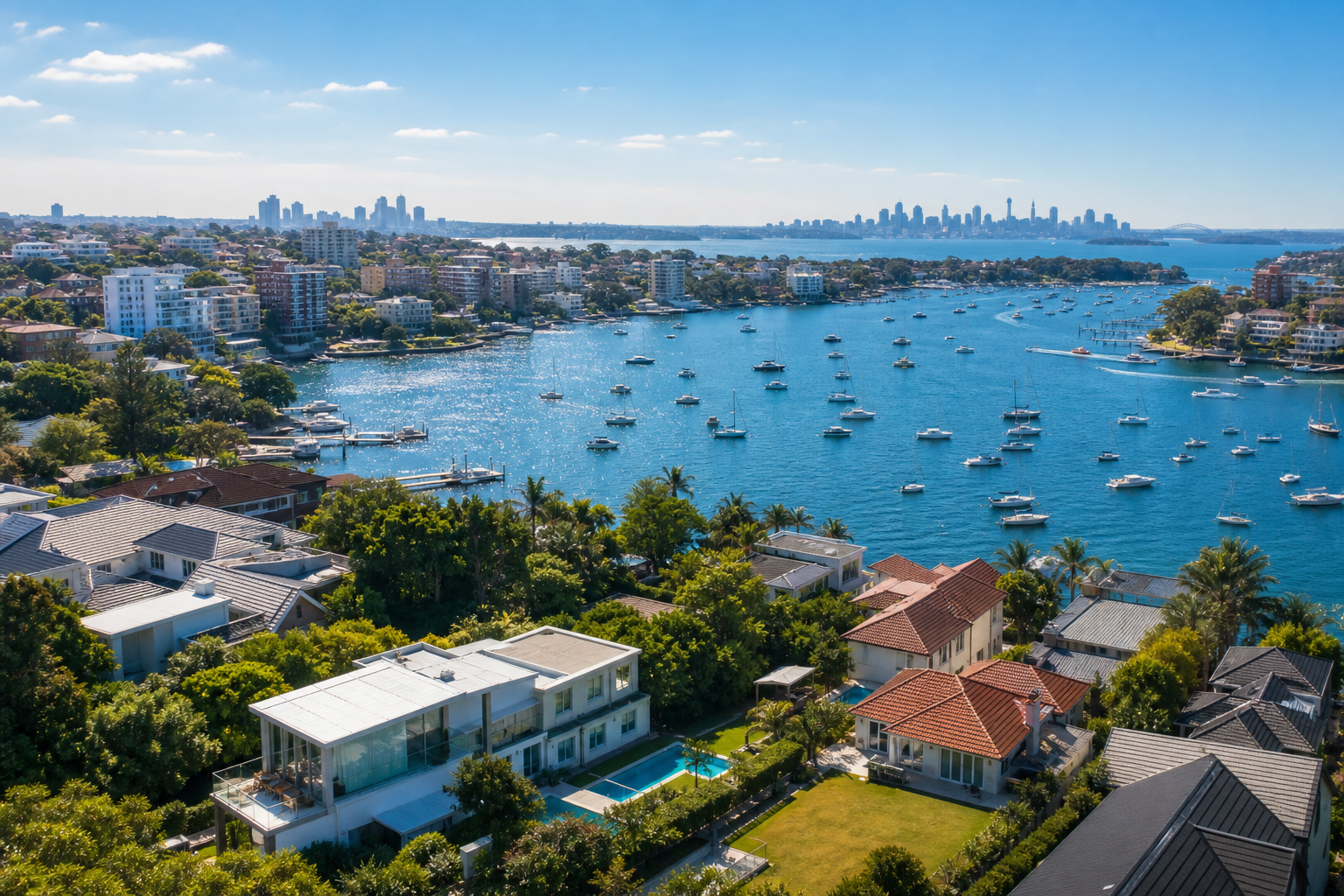
Buying in Rose Bay is less about finding a “dream property” and more about choosing the right strategy for your first or next home. A good Rose Bay plan combines realistic borrowing capacity, the right property type and a loan structure that still works if rates or your income move. This guide shows you, in plain English, how to build that plan and what to do this week.
We’ll cover practical paths for first‑home buyers, upgraders, self‑employed clients and investors who want to live harbourside without over‑stretching themselves.
1. What a Rose Bay home strategy actually is (and isn’t)
A “first or next home strategy” in Rose Bay is simply a set of clear decisions about:
- Where you buy – Rose Bay proper vs nearby suburbs like North Bondi, Dover Heights, Double Bay or Bellevue Hill.
- What you buy – unit vs semi vs house, new vs older, strata vs Torrens.
- How you finance it – deposit source, loan size, repayment structure and buffers.
- What role the property plays – home only, home + future upgrade stepping stone, or part of a longer‑term investment plan.
It’s not about timing the absolute bottom or finding a unicorn deal.
In a premium suburb like Rose Bay, the families who end up in the homes they want usually do three things well:
- They set guardrails (maximum loan, maximum repayment as a share of income, minimum cash buffer).
- They sequence moves (e.g. unit first, then semi or house; or rentvest now, move in later).
- They match lending structure to life plans (kids, school zones, business growth, retirement).
If you can get those decisions roughly right this week, you’re already ahead of most buyers.
2. Can you actually afford Rose Bay? Getting a clean number
Before you fall in love with a harbourside listing, you need two numbers:
- Bank‑assessed borrowing capacity – what a lender is likely to approve.
- Personal comfort limit – the maximum repayment you’re genuinely happy to live with.
2.1 How banks think about Rose Bay borrowers
Most banks don’t care where the property is; they care whether you can repay the debt under stress. For Rose Bay‑level prices, three rules matter:
- APRA buffer: Banks must test your loan at at least 3% above the actual rate (APRA). If a rate is 6% p.a., your affordability is tested around 9%.
- Income vs debts: They look at your tax‑verified income (PAYG or self‑employed), subtract a standard living cost like HEM, then layer in all debts (home, car, HECS, credit cards – usually the limit, not just the balance).
- Debt‑to‑income ratios: Many lenders become cautious when total debt is more than 6× your gross income, especially at higher price points.
For high‑income, self‑employed or complex situations, a broker who understands both residential and business lending can separate personal and business debts cleanly, improving how your situation looks on paper (see /insights/coordinating-personal-company-smsf-borrowing-premium-property-plan).
2.2 Your personal stress test
Regulators focus on whether you can repay. You also need to ask whether you’ll still like your life while doing it.
A good rule of thumb from Australian housing research is that housing costs above roughly 30–40% of net take‑home income are linked with higher financial stress, particularly when it’s tied up in a single high‑value property.
So for example, if your household brings in $18,000 per month after tax:
- 30% of that is $5,400.
- 40% is $7,200.
If a Rose Bay loan pushes your repayments towards $8,000–$9,000 a month, you’re probably outside a comfortable zone unless your income is very resilient and you have strong buffers.
2.3 A worked example: a typical Rose Bay apartment
Assume you’re eyeing a Rose Bay apartment around $1.5 million.
- 20% deposit (no LMI) = $300,000 plus stamp duty and costs.
- Loan amount = $1.2 million.
- On a 30‑year principal and interest loan at an illustrative 6% p.a.:
- Monthly repayment ≈ $7,200.
If your household net income is around $18,000 per month, that repayment is about 40% of take‑home pay. That may be fine for a high‑earning couple with stable roles and no kids yet; much less so for a single income with children in private school.
This is why the first real decision is often not “Rose Bay: yes or no?” but “Rose Bay unit vs bigger home somewhere close by?”

Clarifying your numbers first makes every Rose Bay property search more focused.
3. Smart first‑home paths into Rose Bay and harbourside Sydney
For first‑home buyers, Rose Bay can feel out of reach – but the goal might not be “forever home now”. A better question is: “What’s the smartest way to get a foothold in this area?”
There are four main strategies.
3.1 Smaller in Rose Bay: units and older stock
For many first‑home buyers, the entry point is:
- A one‑ or two‑bedroom unit in an older low‑rise block.
- Sometimes a smaller, slightly dated apartment in a prime street rather than a renovated one further back.
Pros:
- You’re in the suburb – schools, ferries, parks, lifestyle.
- Strong long‑term demand and scarcity.
Trade‑offs:
- Less space and storage.
- Strata levies (and potentially higher in older blocks needing work).
Older units can be easier for lenders than very small, serviced or high‑rise apartments, which some banks restrict. A local broker with building‑specific knowledge can flag issues early.
3.2 “Near‑Rose Bay” instead of Rose Bay
The next option is to buy in a neighbouring suburb that shares much of the lifestyle but at a lower entry price or for more space:
- North Bondi or Bondi for young professionals.
- Bellevue Hill or Double Bay for families.
- Slightly inland pockets of Dover Heights or Vaucluse depending on budget.
Here, your strategy is to buy a more liveable home (or more bedrooms) while still being within a short drive or bus ride of Rose Bay village, schools and the harbour.
3.3 Rentvesting: invest first, live in Rose Bay later
If buying where you want to live right now is unrealistic, rentvesting can be a powerful step.
- You rent in Rose Bay (or nearby) for lifestyle and schools.
- You buy an investment property in a more affordable market that grows your equity.
Pros:
- You can live where you want years earlier.
- Investment mortgage interest is often tax‑deductible (ATO), depending on your circumstances.
Trade‑offs:
- You don’t get the full main residence CGT exemption on the investment property.
- Emotionally, you may still feel like a “renter” even while you’re building wealth.
3.4 Using government schemes safely
If you qualify, schemes like:
- First Home Guarantee (FHBG) – buy with as little as 5% deposit without LMI.
- Help to Buy / shared equity (if available in NSW at your time of purchase).
- First Home Super Saver (FHSS) – save inside super for tax advantages.
can help you get in sooner, especially when combined intelligently.
But Rose Bay values mean you’re more likely to bump into price caps for grants and guarantees.
For a step‑by‑step view of stacking schemes, reducing debts and tidying your file, see:
- /insights/navigating-sydney-first-home-buyer-market-2026
- /insights/sydney-first-home-buyer-market-2026
If you’re self‑employed or run a small business, timing your application and tax returns is critical – /insights/first-home-buyer-small-business-owner-guide walks through that in detail.
3.5 Comparing common first‑home paths (illustrative)
Below is an illustrative comparison based on an example $1.5m budget. Numbers are rounded and for education only – your actual figures will differ.
| Strategy | Example purchase price | Loan at 80% LVR | Approx. 20% deposit* | Pros | Trade‑offs |
|---|---|---|---|---|---|
| 2‑bed unit in Rose Bay | $1.50m | $1.20m | $300k | In‑suburb, lifestyle, strong demand | Smaller, strata, high repayments |
| Larger unit in nearby suburb | $1.30m | $1.04m | $260k | More space, still close to harbour | Not technically Rose Bay |
| House further from harbour | $1.20m | $0.96m | $240k | Yard, family‑friendly | Longer commute to Rose Bay amenities |
| Rentvest (investment elsewhere) | $800k investment | $640k | $160k | Lower entry cost, tax benefits | You’re still renting where you live |
*Excludes stamp duty and purchase costs. For low‑deposit paths, LMI or government guarantees change these numbers.
The key message: small shifts in strategy can cut your cash requirement and repayments by six figures, without abandoning the Rose Bay lifestyle completely.
4. Next‑home and upgrade strategies for Rose Bay owners
If you already own in or near Rose Bay, your questions shift from “How do I get in?” to “How do we step up safely?”
Common scenarios:
- Unit to semi or house in Rose Bay.
- Semi to larger family home, often to lock in school zones.
- Moving closer to the water, or to single‑level living later in life.
4.1 Three main upgrade paths
Upgrading while you hold an existing property usually means choosing between:
-
Sell first, then buy
- You know exactly how much equity you have.
- Lower risk of holding two large loans at once.
- But you may need temporary accommodation if you can’t line up settlement dates.
-
Bridging finance (buy before you sell)
- You secure the next home before putting your current place on the market.
- Short‑term loan covers both properties; once you sell, the bridging loan clears.
- Higher short‑term repayments and stricter lender rules; not all banks offer it.
-
Keep the current home as an investment
- Turn your current Rose Bay or nearby property into a rental.
- Use its equity to fund a deposit on the next home.
- Complex tax, serviceability and risk questions – but powerful if done well.
For a deeper dive into these options, including worked numbers and lender rules, see /insights/financing-major-home-upgrade-managing-existing-property.
4.2 Guardrails that matter in a harbourside market
In a high‑price area, it’s tempting to “stretch just a bit more”. Three guardrails help you stay out of trouble:
- Maximum LVR: Many upgraders cap their home at 80% LVR or less to avoid LMI and keep flexibility. Above that, repricing or refinancing can be harder later.
- Total debt cap: Decide a hard ceiling (e.g. no more than 6× gross income in total debt across home, investment and business) and stick to it.
- Minimum cash buffer: Aim for 3–6 months of total living costs, including mortgage, in offset or high‑interest savings.
These are personal decisions, not bank rules – but they matter just as much as your approval limit.
4.3 Structuring loans for homes plus investments
If you’re keeping an existing property as an investment while upgrading your home:
- Keep loan splits clearly separated by purpose (home vs investment vs business) to preserve tax deductibility later.
- Remember: in Australia, interest deductibility is about the purpose of the borrowing, not the security used.
- If you redraw or top up, document what the extra funds are for.
An adviser who understands both tax and lending can help avoid expensive mistakes here.
5. Self‑employed and business owners: buying well in Rose Bay
For self‑employed buyers and small‑business owners, Rose Bay borrowing isn’t just about income; it’s about how that income shows up on paper.
5.1 Show enough income, even if it means paying some tax
Two facts to keep in mind:
- Aggressive tax minimisation that cuts taxable income in the 1–2 years before applying can slash borrowing capacity, often by more than the tax saved.
- Self‑employed off‑the‑plan buyers who minimise income too aggressively before settlement risk not being able to complete when banks reassess.
If Rose Bay is on the horizon, plan your next two financial years deliberately – your accountant should know you’re preparing for a significant loan application. /insights/first-home-buyer-small-business-owner-guide sets out a one‑week clean‑up plan.
5.2 Separating business and personal debt
Banks will usually treat business loans, leases and credit cards as personal commitments when testing your home loan serviceability.
This means:
- Equipment finance and vehicle leases affect how much you can borrow for a home.
- Consolidating messy business debt first may actually increase your home loan options.
Brokers who understand both sides can often restructure so business debts sit where they belong (company or trust), while your personal balance sheet – which the home lender cares about – looks cleaner. That’s especially important when coordinating personal home, business premises and SMSF lending (see /insights/coordinating-personal-company-smsf-borrowing-premium-property-plan).
5.3 Documentation and lender choice
For Rose Bay‑sized loans, most borrowers will be better served by full‑doc lending once they have:
- At least two years of tax returns (personal and business).
- Clear financials showing stable or rising income.
Alt‑doc can be a bridge, but graduating to full‑doc usually gives you better pricing and more lenders.
6. Timing, negotiation and property choice around Rose Bay
Once your numbers are clear, strategy becomes much more practical.
6.1 What to prioritise in Rose Bay properties
In harbourside areas, long‑term value tends to follow:
- Land and light – even in units, good natural light and outlook matter.
- Walkability to transport, cafes and the harbour.
- School catchments and proximity to childcare.
If budget is tight, you’re often better off taking an older, unrenovated property with strong fundamentals over a beautifully finished place in a compromised position (dark, noisy, poor layout).
6.2 When to compromise – and when not to
Good compromises:
- Cosmetic work you can stage over 3–10 years.
- A smaller second bedroom now if it gets you into the right school zone.
- Lack of parking if walkability and public transport are genuinely strong.
Poor compromises:
- Pushing repayments so high that you’re relying on bonuses or overtime to cover them.
- Buying into buildings with known structural or cladding issues.
- Locking into a product structure you don’t understand (e.g. interest‑only with no exit plan).
A broker who lives in this market can also help you navigate auctions, off‑market deals and fast finance deadlines – see the cluster article on Auctions, Off‑Market Opportunities and Fast Deals in Rose Bay once it’s live.
6.3 Why a broker is almost mandatory at this price point
Around 70% of new Australian home loans now go through brokers. In high‑price suburbs, the credit policies, LVR limits and servicing rules across lenders vary more than most people realise.
A good broker will help you:
- Model different property and loan scenarios.
- Use government schemes safely, if you qualify.
- Negotiate with your current lender or refinance if needed.
Use /insights/mortgage-brokers-first-home-buyers-australia as a checklist for what you should expect.
7. A one‑week action plan for Rose Bay first and next homes
You don’t need to solve everything this week. You do need a clear next move.
Day 1–2: Clarify money and guardrails
- Pull recent payslips, tax returns and business financials (if any).
- List all debts, credit cards and limits.
- Decide your maximum monthly repayment and minimum cash buffer.
- Set a personal maximum total debt (for example, no more than 6× gross income).
Day 3–4: Get a borrowing capacity range
- Speak with a broker or lender to get a bank‑view borrowing capacity based on APRA’s 3% buffer.
- Ask them to model at least three scenarios:
- Rose Bay unit.
- Bigger place in a nearby suburb.
- Rentvesting (investment elsewhere, rent in Rose Bay).
- Ask what would need to change (debts repaid, income, deposit) to shift each scenario by 10–20%.
Day 5: Match strategy to life stage
- If you’re a first‑home buyer, read:
- If you’re planning a major upgrade, review /insights/financing-major-home-upgrade-managing-existing-property.
- If you’re self‑employed, work through /insights/first-home-buyer-small-business-owner-guide.
Day 6–7: Shortlist properties and tighten the plan
- Based on your numbers, shortlist 2–3 realistic strategies (e.g. Rose Bay unit now vs rentvest then move later).
- Set search criteria: location boundaries, minimum size, must‑haves and red flags.
- Organise a broker review of your existing home loan if you own already – sometimes a refinance boosts your next borrowing capacity or cash buffer.
By the end of the week, you won’t just be browsing. You’ll have guardrails, numbers and a clear plan for your first or next Rose Bay home.
Key takeaways
- Rose Bay buying decisions should start with borrowing capacity plus personal comfort limits, not the dream listing.
- Small strategy shifts – unit vs house, Rose Bay vs nearby, own‑to‑live vs rentvest – can change required cash and risk by six figures.
- Upgraders should set clear guardrails on LVR, total debt and buffers before choosing between selling, bridging or keeping an existing property.
- Self‑employed buyers need to plan tax and business debt with lending in mind for at least two years before a big purchase.
- A one‑week plan focused on numbers, not listings, will get you closer to a workable Rose Bay home strategy than months of casual scrolling.
If you’d like a decision‑grade view of your options – first home, upgrade or complex self‑employed situation – speak with a broker who understands both Rose Bay property and how banks really assess you.
General advice only
Frequently asked questions
Talk to a CPA-certified broker
Free consultation, plain-English advice tailored to your situation.
