
Ding Financial logo

Article

Tidy Your Debts So Lenders Say Yes To Your Home Loan

A practical, decision-grade guide to cleaning up personal and business debts before you apply for a home loan, especially if you’re self-employed or run a small business.

Published 21 May 2026Updated 21 May 202613 min read

Key Takeaway

To improve home loan approval odds, borrowers should reduce or restructure high-impact personal and business debts so monthly commitments fall before lenders apply APRA’s 3% serviceability buffer. Because banks often assess 3–4% of each credit card limit as a monthly repayment, cutting unused limits can quickly boost borrowing power. The most effective step is a one-week clean-up: map all facilities, shrink revolving credit, manage ATO debts, and only then consider carefully structured consolidation.

Tidy Your Debts So Lenders Say Yes To Your Home Loan

Getting a home loan approved when you have business commitments is absolutely possible, but you can’t ignore your debts. Managing personal and business debts before applying means reducing or restructuring high-impact facilities, cleaning up your credit conduct, and clearly separating business and personal obligations so lenders are comfortable you can afford the loan even if rates rise or your income dips.

In practice, this week you should: (1) list every personal and business debt, (2) cut unnecessary card limits and BNPL, (3) sort ATO and tax issues, and (4) only then consider debt consolidation. The aim is to lower your assessed monthly commitments, not just shuffle balances around.

Self-employed Australian reviewing personal and business debts Start by mapping every personal and business debt in one place.

1. Why your debts matter so much to home lenders

1.1 How banks measure your commitments

When a bank assesses your home loan, they care less about the size of each debt and more about the monthly repayment they must use in their calculator.

They typically look at:

  • Actual or assessed repayments on each loan, card or facility.
  • Credit card and overdraft limits, not just balances. Many lenders assume 3–4% of the limit as a monthly commitment.
  • A serviceability buffer – APRA expects banks to check you can afford repayments if rates were at least 3% higher than today.
  • A minimum living expense benchmark (HEM) plus your declared expenses.

So if you have a $20,000 card with only $2,000 owing, the bank might still plug in a $600–$800/month ‘repayment’ in the calculator. Multiply that across a few cards and you can lose tens or even hundreds of thousands of dollars of borrowing capacity.

1.2 Personal vs business debts – what really counts

For self-employed borrowers and company directors, the line between personal and business debt is blurry.

Most Australian lenders will:

  1. Treat any facility with a personal guarantee as your personal commitment, even if it’s ‘business use’ and paid from the business account.
  2. Include vehicle loans, leases and novated leases in your personal commitments, even when the car is used largely for work.
  3. Look closely at overdrafts, business credit cards and trade creditors if they are consistently at or near limit.
  4. Ask about ATO debts – and generally expect either no debt or a formal, well-conducted payment plan before approval.

That’s why tidying your “business debts” is just as important as paying attention to your personal cards and loans.

1.3 Why income volatility makes debt more dangerous

Because APRA’s 3% buffer applies to whatever rate you pay, self-employed borrowers with variable income feel the impact more. A bank might test a 6% actual rate at 9% in their calculator.

If your income can move 30–50% year to year, every extra dollar of fixed monthly repayments bites harder. Reducing high-impact, non-productive debts is one of the fastest ways to offset that volatility and still qualify for the loan you want.

For more on how banks read your numbers, see How Banks Read Your Business Financials Before a Home Loan.

2. Map your debt landscape in one sitting this week

You can’t manage what you haven’t listed. Block out 60–90 minutes and get everything in one place.

2.1 Create a master list of all debts and facilities

Gather:

  • Personal: home loan, investment loans, personal loans, HECS/HELP, credit cards, store cards, BNPL, personal overdrafts.
  • Business: overdrafts, credit cards, equipment or vehicle loans, lines of credit, trade finance, merchant cash advances, ATO payment plans.

For each, note:

  • Lender or provider.
  • Whose name it’s in (personal, company, trust).
  • Limit and current balance.
  • Interest rate (approximate is fine).
  • Minimum or actual monthly repayment.
  • Whether there’s a personal guarantee.

You’ll quickly see how many small, high-interest or barely-used facilities you’re carrying.

2.2 Spot the high-impact “debt killers”

From a home loan perspective, the worst offenders are usually:

  • Credit cards and personal overdrafts – assessed on limit, often at 3–4% per month.
  • BNPL and consumer finance – many lenders now treat these as ongoing commitments, and frequent small transactions clutter your bank statements.
  • Short-term personal loans – big monthly repayments with only a small remaining balance.
  • Maxed-out business cards or overdrafts – especially where you’ve given a personal guarantee.

These are the ones to attack first. Revenue-generating business loans on sensible terms usually hurt you far less than a wallet full of unused plastic.

For a deeper dive into how each debt type hits your borrowing power, read Business Debts, Credit Cards and Car Loans: Protect Your Borrowing Power.

2.3 Check and clean your credit reports

Next, order a copy of your personal credit report from all major bureaus. Look for:

  • Incorrect defaults or enquiries.
  • Old facilities that should be closed.
  • Payment history issues on cards, phones and utilities.

As a small business owner, your personal credit file is often used for both home loans and many business facilities. Fixing errors, catching up any late payments and closing dead accounts can quickly improve how you look on paper.

Our step-by-step guide, Clean up your credit file as a small business owner this week, walks through this process in detail.
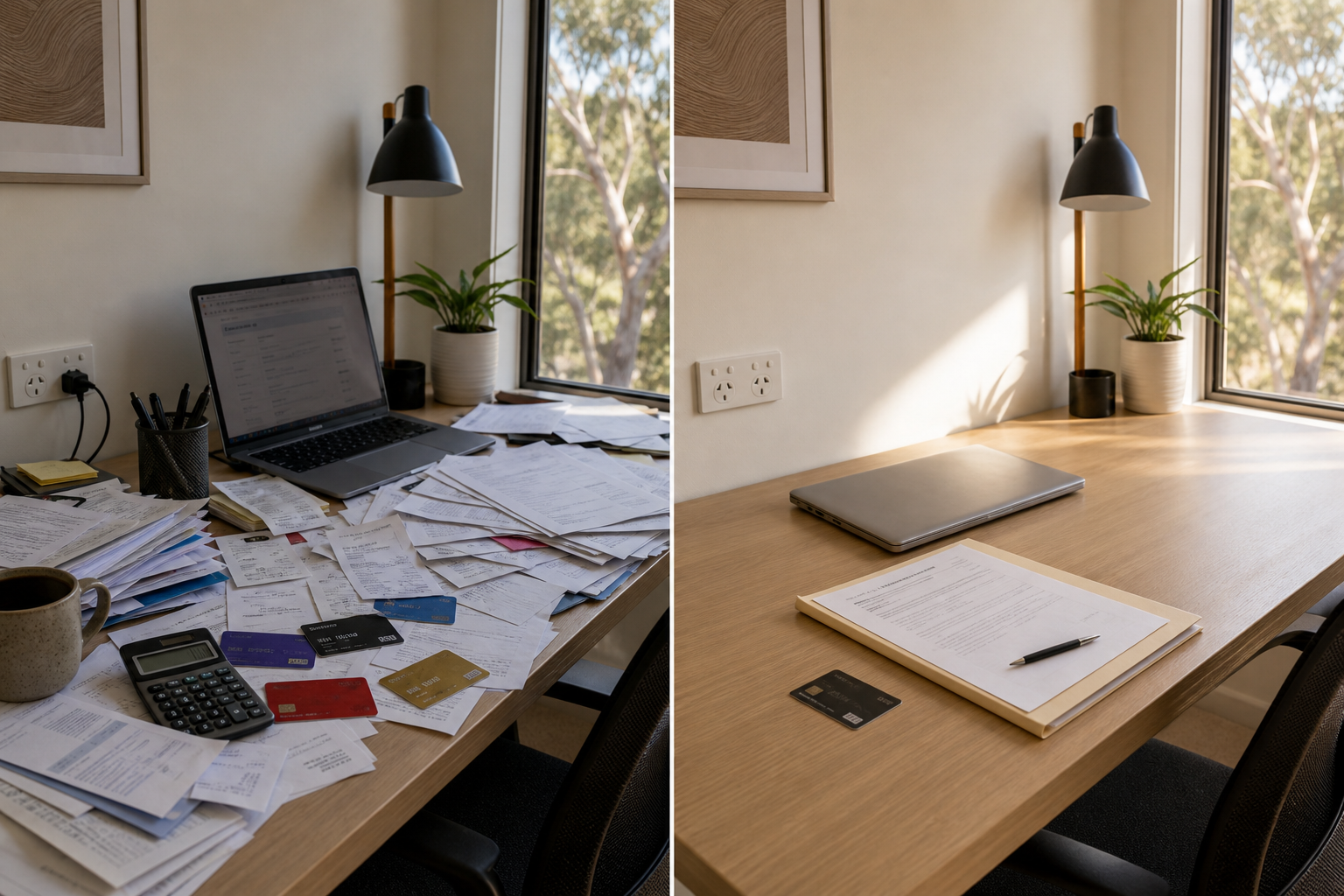
Before and after snapshot of debt consolidation A smarter structure can reduce monthly commitments without starving your business of cash.

3. Quick wins that move the needle fast

Once you know what you’re dealing with, go after the changes that have the biggest impact for the least cash.

3.1 Slash revolving credit limits

Because lenders assess limits, not balances, reducing your available revolving credit can be more powerful than making a one-off extra repayment.

Consider:

  • Cutting unused or excessive credit card limits. If you have three cards at $15,000 each and only need one at $8,000, drop the rest.
  • Cancelling rarely used cards, store cards and personal overdrafts.
  • Replacing multiple small cards with a single, lower-limit card if you genuinely need one for work or travel.

Worked example (illustrative only):

  • Before: 3 cards x $15,000 limit = $45,000. Bank assumes 3.5% per month = $1,575/month.
  • After: 1 card x $8,000 limit = $8,000. Bank assumes 3.5% per month = $280/month.

You’ve reduced assessed monthly commitments by about $1,295. At typical assessment settings, that can easily free up well over $150,000 of home loan borrowing capacity, without spending a cent.

3.2 Clear small nuisance debts and BNPL

If you have:

  • A personal loan with < $3,000 remaining and a $250/month repayment; or
  • Several BNPL facilities with overlapping instalments;

it’s often worth clearing these out before you apply.

Benefits:

  • Fewer lines on your credit report and bank statements.
  • Lower total assessed monthly commitments.
  • A cleaner story to tell the lender about your spending habits.

Do not, however, empty your entire home deposit buffer or business cash reserves just to kill off every tiny debt. Prioritise the ones with high repayments and little strategic value.

3.3 Sort ATO debts and tax lodgements

Most mainstream lenders expect that self-employed borrowers will have:

  • All recent tax returns lodged; and
  • Either no ATO debt, or a formal payment plan that’s up to date.

If you do have ATO debt:

  • Talk to your accountant about formalising a payment plan if you haven’t already.
  • Make sure all instalments have been paid on time for at least 3–6 months.
  • Be ready to explain what caused the debt and how it won’t recur.

In many cases, consolidating ATO debts into a home loan or other facility is possible, but it invites more scrutiny of your tax compliance and business health. Get advice before you go down that path.

4. Restructuring bigger debts: should you consolidate?

Once the quick wins are handled, you can look at whether debt consolidation will help or hurt.

4.1 When debt consolidation makes sense

Debt consolidation usually means rolling multiple higher-rate debts into a single loan at a lower rate – often a home loan or home equity facility.

It can make sense when:

  • You have several personal loans and cards at high rates.
  • The new facility has a meaningfully lower rate.
  • You commit to not re-using the freed-up cards or limits.
  • You keep the term tight enough that you’re not paying interest for decades on short-lived purchases.

Our guide Demystifying Debt Consolidation: Using Your Home Equity Wisely gives a detailed framework and one-week checklist.

4.2 Risks for self-employed and business owners

For business owners, there are extra traps:

  • Using a 30-year home loan to fund short-lived business assets (equipment, fit-outs) can massively increase total interest cost.
  • You’re concentrating business risk onto the family home.
  • Rolling business or ATO debts into the home loan can make lenders probe deeper into your business stability and tax compliance.

As a rule of thumb, home loan debt is best reserved for long-term, productive assets – your home, quality investments, or foundational business assets with a long life. Match shorter-lived assets to shorter-term business facilities where possible.

4.3 Before-and-after consolidation: an illustrative example

Here’s a simplified, indicative comparison to show how consolidation can change assessed commitments. These numbers are for illustration only and not a quote.

ScenarioDebtsTotal BalanceAverage Rate (p.a.)Assessed Monthly CommitmentsIndicative Borrowing Capacity Impact*
A. Before2 credit cards ($10k + $8k), personal loan $20k$38,00016% cards, 12% loan$350 + $280 (cards, at 3.5% of limits) + $600 (loan) = $1,230Baseline
B. After: consolidate to 5-year personal loanSingle $38k personal loan$38,00011%Approx $830May improve borrowing capacity by equivalent of ~$70k–$120k
C. After: consolidate into 25-year home loan top-upAdded to home loan$38,0006%Approx $245May improve borrowing capacity by equivalent of ~$150k–$250k

*Indicative only. Actual impact depends on income, other debts, lender policy and HEM.

Notice Scenario C frees up the most cash flow but stretches the debt over a much longer period. If you go this route, you can use features like offset accounts or extra repayments to avoid turning short-term debt into 25–30 years of interest.

Broker and small business owner reviewing debt options Specialist advice can show how different debt strategies affect borrowing power.

5. Business loans and your mortgage borrowing power

5.1 Which business facilities hurt most?

From a home lender’s point of view, not all business debts are equal. The ones that usually hurt your borrowing power most are:

  • Business credit cards and overdrafts with personal guarantees, especially if they’re near the limit.
  • Short-term cash-flow facilities (e.g. merchant cash advances) with chunky weekly repayments.
  • Vehicle leases and loans that are effectively personal benefits (family cars etc.).

By contrast, a well-structured, longer-term term loan funding productive equipment can be easier for a lender to live with, particularly if your financials clearly show it supporting revenue and profit.

5.2 Tidy-ups that impress both the bank and your accountant

Depending on your situation, useful moves might include:

  • Refinancing short-term, high-repayment business facilities into a slightly longer term to cut monthly commitments (without overextending the term beyond the asset life).
  • Moving genuinely business-related expenses back into the business and off personal cards.
  • Shifting ad-hoc director drawings into a more stable salary or regular drawings pattern, so your income story is clearer.
  • Keeping business and personal banking separate so it’s obvious which commitments belong where.

These changes won’t just help the home loan; they usually make your business easier to manage and your tax position clearer.

5.3 Protecting business cash while improving serviceability

The worst thing you can do is drain your business of working capital just to look “debt free” on paper.

Instead:

  • Prioritise reducing limits and cleaning up structures before throwing large lumps of cash at debt.
  • Pay out or restructure high-repayment, non-productive facilities first.
  • Maintain a sensible business buffer – lenders look favourably on borrowers whose income source looks resilient.

If you’re buying a first home, read Buying Your First Home When You Run a Small Business for how to balance deposit size with business stability.

6. The one-week “debt ready” action plan

You don’t need to fix everything this week, but you can put a concrete plan in place.

Step 1: Map and prioritise (Day 1–2)

  • Build your master debt list with limits, balances and repayments.
  • Highlight:
    • Revolving credit (cards, overdrafts).
    • Short-term loans, BNPL and cash-flow facilities.
    • Any ATO or tax-related debts.
  • Mark which debts:
    • Could be reduced via limit cuts.
    • Should be cleared quickly.
    • Might be candidates for consolidation.

Step 2: Implement quick-limit and account changes (Day 2–3)

  • Apply online to reduce limits on cards you intend to keep.
  • Cancel unused cards and overdrafts if closing them won’t disrupt your cash flow.
  • Close dormant BNPL and store accounts.

Keep email confirmations and screenshots – they can be useful if the changes don’t hit your credit file or statements before you apply.

Step 3: Clean up credit and conduct (Day 3–4)

  • Order your credit reports and dispute any obvious errors.
  • Bring any late payments (cards, utilities, phones) up to date.
  • Set up direct debits or calendar reminders so nothing falls overdue from here.

Over the next 3–12 months, consistent on-time payments build a strong pattern that lenders like.

Step 4: Deal with ATO and business debts (Day 4–5)

  • Speak with your accountant about:
    • Lodging any overdue returns.
    • Formalising or restructuring any ATO debts.
  • Review business facilities for opportunities to:
    • Refinance expensive short-term debt.
    • Shift personal-use spending off business accounts (and vice versa).
    • Right-size limits to what you actually need.

Step 5: Sense-check consolidation and next moves (Day 5–7)

Before pulling the trigger on any consolidation:

  • Run the numbers on total interest cost and term.
  • Check the impact on monthly commitments – that’s what the bank will key off.
  • Make sure you’re not undermining your business cash flow or taking on unnecessary risk against the family home.

This is often the point where speaking with a broker who understands self-employed lending is worth it. They can show you how different debt clean-up options will translate into borrowing capacity with real lenders.

For more on how specialist brokers help in this space, see Smarter mortgage broking for self‑employed, professionals and owners.


FAQs: Managing debt before a home loan application

How far in advance should I start cleaning up my debts before applying?

Ideally, start 6–12 months before you plan to apply. That gives time for limit reductions and closed accounts to flow through to your credit file and for you to build a solid record of on-time payments. If you’re shorter on time, you can still improve things in a few weeks, but lenders may weigh your recent conduct more heavily.

Is it better to pay off my credit cards completely or just reduce the limits?

From a serviceability point of view, reducing limits often has a faster impact than making big one-off repayments, because lenders assess a percentage of the limit. In a perfect world you’d both clear balances and lower limits, but if cash is tight, cutting unnecessary limits is usually the first move. Just avoid re-spending on those cards once limits fall.

Will closing old credit cards hurt my credit score?

Closing a long-held card can slightly reduce the average age of your accounts, which may nudge your score, but the impact is usually minor compared to the benefit of lower assessed limits and fewer active facilities. Lenders are generally more interested in your current conduct and total commitments than whether you kept an old unused card open.

Should I consolidate all my debts into my home loan before I apply?

Not always. Consolidating into your home loan can slash monthly repayments and improve borrowing power, but it can also stretch short-term spending over decades and increase total interest cost. It’s usually best for higher-rate, non-deductible debts where you commit to keeping the term tight and not re-borrowing on the freed-up cards.

Can I get a home loan if I still have ATO debt?

Some lenders will consider applications where there is ATO debt, but they typically want a formal payment plan in place and at least several months of spotless conduct. You’ll also need lodged, up-to-date returns. If the debt is large or recent, expect closer scrutiny of your business performance and cash flow.

Do business loans always count against my personal borrowing capacity?

Not always, but many do. Facilities with personal guarantees, business credit cards, overdrafts and vehicle finance are commonly treated as personal commitments. Longer-term, income-generating business loans may be looked at more leniently if your financials clearly show they are self-supporting. This is where structuring and documentation matter.


Key takeaways

  • Lenders focus on your monthly commitments and limits, not just balances, and apply a 3% interest rate buffer to test affordability.
  • Cutting unused and excessive credit card and overdraft limits is often the fastest way to boost borrowing power, especially for self-employed borrowers.
  • Clean, up-to-date credit conduct, lodged tax returns and well-managed ATO debts are critical before you apply.
  • Consolidation can help, but only if you control the term, avoid re-borrowing and don’t destabilise your business cash flow.
  • Separating business and personal finances and right-sizing business facilities reassures lenders that your income source is sustainable.

If you’d like a second set of eyes over your current debts and a clear plan to become “lender-ready” without putting your business at risk, a specialist broker who understands both tax and lending can map out your options in plain English.

General advice only.

Frequently asked questions

Ideally, start 6–12 months before you apply for a home loan. That allows time for limit reductions, account closures and improved payment behaviour to flow through to your credit file and bank statements. You can still make improvements in a shorter window, but lenders will pay close attention to your most recent 3–6 months of conduct.

Talk to a CPA-certified broker

Free consultation, plain-English advice tailored to your situation.

Your details are kept confidential. We’ll never share them.