
Article
Using Your Home Loan to Pay for Solar: A Practical Guide
Thinking about adding solar panels and wondering whether to put them on your home loan? This guide explains how solar interacts with your mortgage, the main finance options, and when topping up, refinancing or using a separate split actually makes sense.
Key Takeaway
Australian homeowners can fund solar panels through their home loan by topping up using equity, refinancing with extra cash out, or creating a separate short-term loan split secured against the property. Because most lenders assess serviceability using a rate at least 3 percentage points above the actual rate, extending a $15,000 solar system over 30 years at 6% can add about $17,000 of interest versus roughly $3,400 over 7 years. The most effective strategy is to keep any solar-related split on a much shorter term than the main mortgage.

In Australia, you can fund a solar system through your home loan by topping up using equity, refinancing with extra cash out, or adding a separate ‘solar’ loan split secured against your property. This often gives you a lower interest rate than a personal loan, but if you stretch the cost over 25–30 years you can easily double what you pay in interest. The real decision is not just can you add solar to your mortgage, but how and on what terms.
This guide steps through the main structures, traps to avoid, and the exact checks to run before you sign a solar contract or touch your loan.
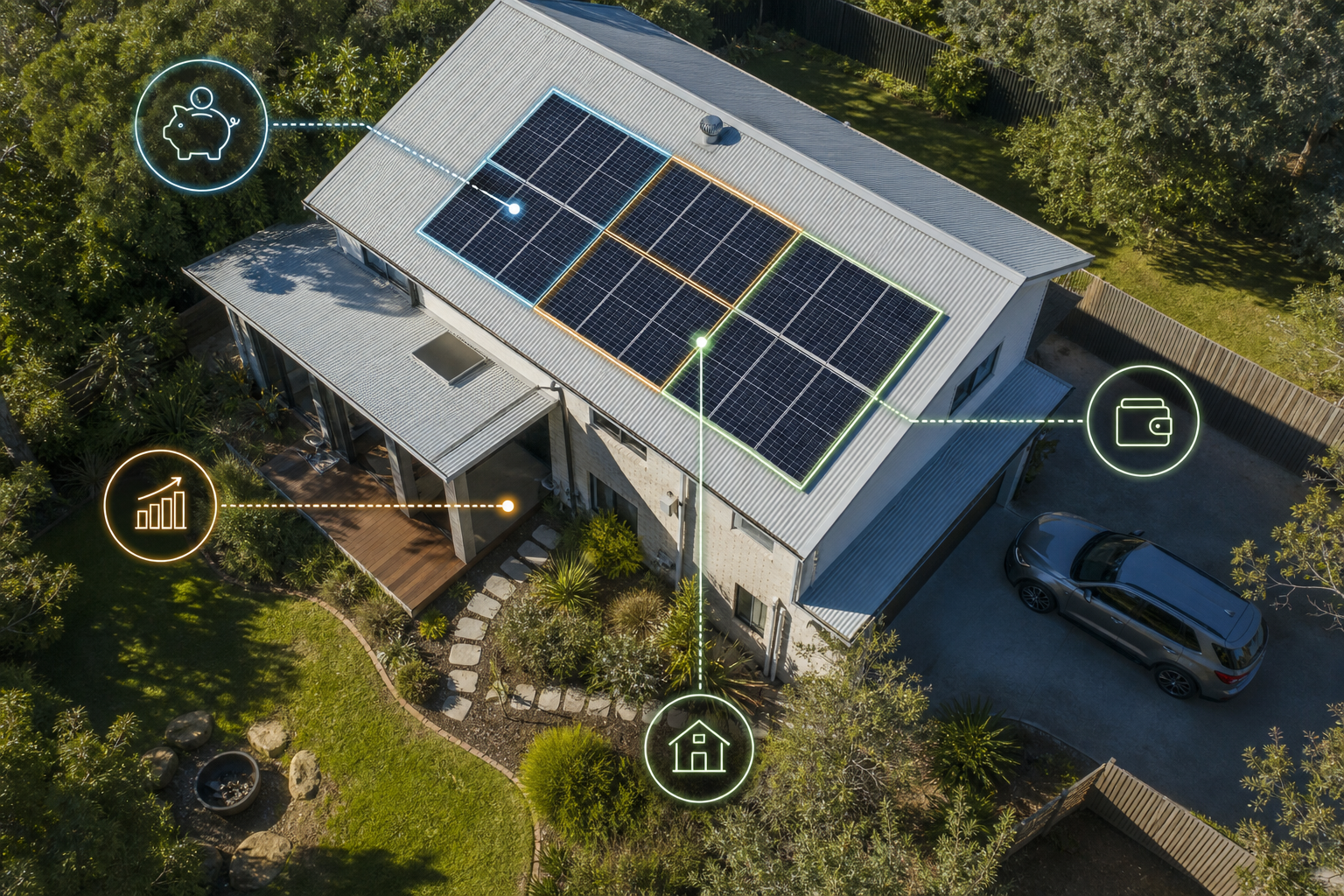
Solar panels change both your power bill and how you think about your home loan.
1. How solar and your home loan actually interact
When you borrow against your home to pay for solar, the lender treats it as a home improvement. The debt is secured by your property, just like the rest of your mortgage, and your total repayments are assessed using a serviceability rate at least 3% above the actual rate, in line with APRA guidance (12,15).
That means three things:
- Your borrowing capacity and repayment comfort matter as much as the system cost.
- Your loan-to-value ratio (LVR) after the top-up or refinance is critical.
- The loan term you choose can make the difference between solar saving you money, or quietly bleeding cash for decades.
Most lenders are comfortable with solar as long as:
- Your post-valuation LVR is within policy (80% or lower usually gives the best choice and pricing (3)).
- You still pass their serviceability test at the higher assessment rate.
- The purpose is clearly documented (home improvement versus investment or business use).
Solar also interacts with tax and cash flow:
- Owner-occupiers: No tax deduction on interest, but you do get lower power bills.
- Investors: When solar is installed on a rental property, interest on the portion of the loan used is generally tax-deductible, plus you may claim depreciation, subject to ATO rules.
- Small businesses/home offices: You may apportion interest and depreciation between private and business use.
Because the RBA cash rate has risen sharply from the COVID-era low to 4.35% in May 2026, putting pressure on mortgage rates and household budgets, getting the structure right before you add more debt is more important than ever.
2. Main ways to finance solar using your home loan
There are four broad ways to line up solar with your mortgage. The right fit depends on your equity, current rate, and how disciplined you are with repayments.
2.1 Top-up using existing equity
A top-up (or equity release) increases your existing home loan limit to fund the solar purchase.
How it works in practice:
- The lender orders a valuation on your property.
- You can usually borrow up to a percentage of the new value (often 80% without LMI; sometimes more with LMI).
- The increase in your limit is paid to you or directly to the installer.
Example – top-up within 80% LVR
- Home value (valuation): $800,000
- Current loan: $520,000 (65% LVR)
- 80% of value: $640,000
- Potential total lending at 80%: $640,000
- Theoretical equity available at 80%: $120,000
If you top up by $15,000 for solar, your new loan becomes $535,000.
- New LVR = $535,000 / $800,000 = 66.9%
You stay comfortably below 80% LVR, so no new Lenders Mortgage Insurance (LMI), and most lenders will treat this as a simple variation if you pass serviceability.
The key decision is whether you:
- Keep the same remaining term, which slightly increases your monthly repayment; or
- Extend the loan back out, which can feel cheaper month to month but badly increases lifetime interest.
2.2 Refinance and add funds for solar
If your current rate is uncompetitive, you might refinance to a new lender and add the solar cost to the new loan.
This can make sense if:
- Your existing loan is clearly above realistic new-customer rates for your LVR band (see how to check in “Spotting an Uncompetitive Home Loan Rate in 2026, Fast”).
- You have enough equity to stay at or under 80% LVR after adding solar.
- The savings from refinancing outweigh any discharge, application and potential break fees.
Watch for a subtle trap: resetting the clock. Refinancing back to a new 30-year term, including your solar top-up, often increases total interest even if the new rate is lower (17). That’s especially painful when you’re funding an asset like solar that might last 20–25 years.
Before refinancing purely for solar, run a stay-versus-switch comparison, including:
- Old vs new rate and fees.
- Old remaining term vs new term.
- Extra interest from stretching the solar portion over a longer period.
For a step-by-step framework, see “How to Decide When Refinancing Your Home or Investment Loan Makes Sense”.
2.3 Separate solar loan split or ‘green’ split
Instead of mixing solar into your main home loan, you can ask for a separate loan split (sometimes marketed as a green loan or sustainability split).
Key features:
- Dedicated account for the solar system only.
- Often a shorter term (e.g. 5–10 years) with principal and interest (P&I) repayments.
- Same or slightly different rate to your main mortgage, but still much cheaper than unsecured personal loans.
This structure aligns with a critical principle: match the loan term to the life of the expense (8).
- Most residential solar systems have a warranty or expected life around 20–25 years.
- A 5–10 year loan term means you’re likely to own the system outright for a decade or more while still enjoying the savings.
Using multiple splits like this also gives you more control. You can target extra repayments to the solar split while keeping your main home loan structure stable (5).
2.4 Funding solar during construction or renovation
If you’re building or doing major renovations, you can usually include solar in your construction loan or renovation budget.
Pros:
- The cost is built into your overall project finance.
- Valuers often treat solar as part of the completed property’s value.
- You avoid multiple loan applications.
Cons:
- Easy to lose visibility of the solar cost within a larger loan.
- Same long-term interest risk if you don’t manage the term carefully.
3. Home loan vs other solar finance options
Solar is often marketed with attractive-sounding finance offers. Your mortgage is just one option.
Below is an illustrative mid‑2026 comparison (actual offers will vary and change).
| Option | Indicative interest rate (p.a.) | Typical term | Secured against home? | Main pros | Key watch-outs |
|---|---|---|---|---|---|
| Pay cash | 0% | N/A | No | No interest, simple, fast | Ties up savings; less buffer for other expenses |
| Home loan top-up (same split) | ~5–7% | Up to 25–30 yrs | Yes | Lowest rate category; easy to arrange | Huge interest if repaid over full mortgage term |
| Separate mortgage split / green loan | ~5–8% | 5–10 yrs | Yes | Lower rate + controlled term; clear purpose | Higher monthly repayment than 25–30 year structure |
| Unsecured personal/solar loan | ~8–14% | 3–7 yrs | No | No impact on property security | Much higher rate; can hurt home loan serviceability |
| ‘No interest’ vendor/BNPL plan | Often equivalent to 10–20%+ | 3–10 yrs | Sometimes indirectly* | Low upfront cost; quick approval | Embedded fees; high effective rate; harsh late fees |
*Some vendor finance arrangements can create ongoing obligations that lenders factor into home loan serviceability.
A home loan–based option usually wins on interest rate, but it only wins overall if you keep the term under control and avoid expensive LMI.

Comparing finance options helps you balance rate, term and total interest.
4. When adding solar to your home loan works well
4.1 When the rate gap is big but you cap the term
The sweet spot is using your mortgage rate plus a shorter term.
Example – $15,000 solar system at 6% p.a.
- 7‑year term:
- Monthly repayment ≈ $219
- Total interest ≈ $3,400
- 25‑year term:
- Monthly repayment ≈ $97
- Total interest ≈ $14,000
- 30‑year term:
- Monthly repayment ≈ $90
- Total interest ≈ $17,000
(All figures approximate, for illustration only.)
On a 25–30 year term, the system can cost almost twice as much in interest compared with a focused 7‑year split, even at the same rate.
If your solar system cuts your power bill by, say, $100 per month ($1,200 per year), a 7‑year loan at $219 per month might still be manageable if your budget is solid. After 7 years, the loan is gone, but the savings continue.
A 30‑year term feels easier at $90 per month, and the power bill savings might fully cover it. But you’re quietly paying an extra ~$14,000 in interest for that comfort.
4.2 When you stay under 80% LVR
An LVR at or below 80% generally unlocks the sharpest rates and widest lender choice because no LMI is required and the lender’s risk is lower (3).
If your solar top-up keeps you under 80%, you can usually:
- Avoid paying a fresh LMI premium (which can easily run into the thousands).
- Access mainstream banks and non-banks with competitive offers.
- Revisit your structure later without being trapped by sunk LMI costs (16).
If the only way to fund solar via your mortgage is to push above 80% LVR and pay LMI, it’s often better to:
- Delay the system while you build equity; or
- Explore a smaller system or alternative finance; or
- Consider a hybrid approach (part cash, part shorter-term loan).
4.3 When solar is clearly linked to income (investors & businesses)
For investment properties:
- Interest on borrowing used for improvements to a rental property, including solar, is generally tax-deductible, provided the property is producing assessable income.
- A separate loan split dedicated to that property and purpose makes the tracing much clearer for the ATO.
For small businesses, especially home-based:
- Part of the system may support your business (e.g. running equipment, air conditioning for a clinic, EV charging for a work vehicle).
- In many cases, you may apportion interest and depreciation between private and business use.
These situations are where a broker with both lending and tax literacy can help structure separate splits so that deductible and non-deductible interest are clearly separated (14). Always confirm deductibility with your tax adviser.
5. When putting solar on your mortgage can backfire
5.1 Stretching a small amount over decades
The biggest danger is psychological. A $15,000 top-up spread over 25–30 years barely moves the needle on your monthly repayment, so it feels harmless.
But as the earlier example shows, the interest blowout is real: roughly $3,400 over 7 years versus up to ~$17,000 over 30 years at the same rate.
The longer the term, the more solar turns from an energy-saving investment into a slow-drip cost. Matching the loan term to the life of the panels (or shorter) is the simplest way to stop this (8).
5.2 Triggering LMI for the sake of solar
If your post-solar LVR jumps above 80%, many lenders will charge LMI or a risk fee. On a typical metro property, that can be $5,000+ in one hit.
When the system itself costs $8,000–$15,000, paying thousands in LMI purely to fund it often wipes out years of energy savings.
Remember, LMI on a refinance generally can’t be transferred between lenders; a new premium is usually payable if your refinanced loan is above the new lender’s LVR threshold (16).
5.3 Pushing yourself into mortgage stress
Roy Morgan research shows around 28% of mortgage holders are now ‘At Risk’ of mortgage stress, with stress levels closely linked to rising interest rates and repayments. Adding more to your home loan for solar might keep your power bill down, but it still increases your minimum repayment and total debt.
Lenders assess new or increased loans with a 3% buffer above the actual rate (12,15), but that doesn’t guarantee you will feel comfortable, especially if your income is variable.
Warning signs that a solar top-up may not be wise right now:
- You’re already cutting back on essentials to make repayments.
- You have little or no emergency buffer.
- You are on a variable rate and worried about further RBA hikes.
- You’re close to the bank’s maximum borrowing capacity.
If that sounds like you, focus first on stabilising your cash flow and simplifying existing debts. The framework in “Demystifying Debt Consolidation: Using Your Home Equity Wisely” is a useful lens before taking on new commitments.
5.4 Fixed rates, break costs and timing
If your current home loan is on a fixed rate, refinancing or restructuring to fund solar may trigger break costs, especially if your fixed rate is higher than prevailing wholesale rates.
Options in that case:
- Keep the fixed loan as-is and use a separate unsecured or green loan for solar.
- Wait until closer to fixed-rate expiry and plan a refinance that includes solar.
- If you must change now, get a very clear written estimate of break costs and compare them to the benefit of a better structure.
6. Structuring solar finance for different borrowers
6.1 Owner-occupiers
For most owner-occupiers, a separate 5–10 year split is the cleanest, safest structure:
- Split A: Main home loan (e.g. 20+ years remaining).
- Split B: Solar split, 5–10 year P&I, sized to the system cost.
You can even set your repayments so that the estimated power bill saving roughly matches the solar split repayment. Any extra saving can go straight into your offset or onto the main loan.
This avoids paying for an aging or obsolete system long after it has stopped delivering full benefit.
6.2 Self-employed and small business owners
If you’re self-employed, lenders look at your business debts and income in detail, often counting business overdrafts, leases and equipment finance as personal commitments for home loan serviceability (10,18).
Adding solar on top of that means you need a structure that:
- Is acceptable to lenders under your documentation pathway (full-doc vs alt-doc, etc. – see “Choosing the right documentation pathway for your next home loan”).
- Keeps business-related borrowing clearly separated for tax and future refinancing.
If your business will benefit materially from solar (e.g. you run a refrigerated warehouse, café, clinic or workshop at home):
- Part of the cost might better sit in a business facility (equipment finance, commercial loan) if cash flow and tax treatment support that.
- Home loan and business loan should be structured so that deductible and non-deductible interest are easy to trace, with separate splits and clear purposes (14).
For a deeper look at how banks view your business at home loan time, see “How Banks Really Judge Your Small Business At Home Loan Time”.
Self-employed, higher-income professionals often have excellent options if their financials are well presented; the guide on “Home loans for high‑income self‑employed professionals and owners” steps through how to get that side right.
6.3 Property investors
For investors, solar can:
- Improve tenant appeal and rental value.
- Reduce vacancy in competitive markets.
- Potentially support a modest rent increase or better-quality tenant profile.
The structure we typically see work best is:
- Separate investment loan split funding the solar, secured against the relevant property.
- Clear records of invoices and borrowing so your accountant can confidently claim interest and depreciation where appropriate.
Avoid mixing owner-occupier and investment purposes in the same loan split, as this complicates tax deductibility and later refinancing.
6.4 Borrowers in their 50s and 60s
If you’re in your 50s or 60s, lenders are already focused on your exit strategy and how the loan will be repaid as you move into retirement (see “Smart borrowing in your 50s and 60s when you’re asset‑rich”).
In this stage of life, it’s rarely sensible to:
- Add 25–30 years of extra debt for solar; or
- Reset the overall mortgage term out to 30 years to keep repayments low.
Better options include:
- A short, targeted solar split that finishes well before your intended retirement date.
- Using some cash savings plus a modest top-up, so the extra loan amount is small.
- Ensuring the loan is still affordable under conservative retirement income assumptions.
A one-week plan is enough to make a confident solar and mortgage decision.
7. A one-week action plan for solar + home loan decisions
If you’re serious about solar and thinking of using your home loan, here’s what to do in the next seven days.
Step 1: Nail the real system cost and savings
- Get at least two detailed quotes with clear system size (kW), components and total installed price.
- Ask each provider for a conservative estimate of annual bill savings based on your usage, not just best-case marketing numbers.
This article sits alongside deeper pieces on solar costs and government incentives; read those for more detail on pricing and rebates before you sign anything.
Step 2: Collect your current loan details
- Current lender, product and interest rate.
- Remaining loan term and balance.
- Monthly repayment and whether you’re in advance.
- Fixed vs variable (and fixed expiry date, if relevant).
Check whether your rate looks uncompetitive using the framework in “Spotting an Uncompetitive Home Loan Rate in 2026, Fast”.
Step 3: Estimate your post-solar LVR
- Get a realistic estimate of your property value (recent local sales, online estimates, or a broker’s view).
- Add the proposed solar cost to your current loan balance.
- Divide the new loan balance by the estimated property value.
If you’d end up above 80% LVR, note the potential LMI issue and be cautious.
Step 4: Run three repayment scenarios
For the solar portion only (say $10,000–$20,000), model:
- Separate 5–7 year split at your mortgage rate.
- 25–30 year term at the same rate.
- Unsecured personal loan over 5–7 years at a higher rate.
Compare:
- Monthly repayments vs expected bill savings.
- Total interest paid under each option.
- How each affects your emergency buffer and lifestyle.
This is the heart of decision-grade analysis.
Step 5: Speak to a broker before signing a solar contract
A good mortgage broker can:
- Confirm realistic borrowing capacity under current APRA buffer rules.
- Test top-up vs refinance vs separate split scenarios across multiple lenders.
- Map the structure to your future plans (e.g. turning the home into an investment, business growth, or downsizing).
If you haven’t worked with a broker before, “Why Using a Mortgage Broker Saves Time, Stress and Money” explains how to do this efficiently in a week.
Step 6: Decide, document and diarise
Once you’ve chosen a path:
- Document the purpose of each loan split clearly.
- Set up automatic repayments high enough to clear the solar split in 5–10 years.
- Diarise a review 6–12 months after installation to check bill savings and consider extra repayments.
FAQs
Is it better to pay cash or add solar to my home loan?
If you have strong cash reserves and no pressing competing priorities, paying cash avoids interest and keeps your mortgage smaller. Adding solar to your home loan can make sense when the mortgage rate is much lower than your alternative finance options, but only if you keep the term short. Always leave yourself an emergency buffer rather than draining savings completely.
Will adding solar to my home loan affect my future borrowing power?
Yes. A solar top-up increases your total debt and minimum repayments, which lenders factor into future applications using a serviceability rate at least 3% above the actual rate. The impact may be modest for a small system, but it can matter if you plan to upgrade, invest or refinance soon. A shorter-term separate split can reduce the long-term drag on borrowing capacity.
Can I use equity from an investment property to put solar on my home?
You can generally release equity from one property and use it elsewhere, including for solar on a different property. However, the purpose of the borrowed funds drives tax treatment, so interest on a loan secured by an investment property but used for your owner-occupied home solar is usually not deductible. Using separate splits tied to each property and purpose keeps things cleaner for tax and future refinancing.
Are there tax benefits if I use my home loan for solar?
For owner-occupied homes, there is usually no tax deduction for interest, but you benefit from lower power bills. For investment properties and certain business uses, interest on the solar portion and depreciation on the system may be deductible, depending on your circumstances and ATO rules. The loan should be structured so the solar cost is in a clearly identified split; then confirm deductibility with your tax adviser.
Can I refinance just to add solar, or should I wait?
You can refinance primarily to add solar, but it only makes sense if you also improve your overall loan position. That means securing a clearly better rate and structure without excessive fees or stretching your term too far. If your current loan is already sharp and the solar amount is small, a simple top-up or separate split with your existing lender may be more efficient.
What if my home loan is fixed and I want solar now?
If you’re on a fixed rate, changing lenders or restructuring the fixed component could trigger break costs. In that case, consider keeping your fixed loan intact and using a smaller unsecured or green loan, or a new variable split if your lender allows it, for the solar. Alternatively, plan ahead to refinance and restructure around the time your fixed rate expires.
Key takeaways
- Using your home loan to fund solar can be smart when you keep the loan term short and stay under key LVR thresholds.
- The biggest trap is stretching a relatively small solar cost over 25–30 years, which can more than double the interest you pay.
- Separate loan splits for solar, investment and business purposes improve flexibility, tax clarity and future refinancing options.
- Self-employed borrowers and investors need to consider how lenders view business debts and how the structure affects deductibility.
- A one-week review of quotes, LVR, repayment scenarios and refinance options, ideally with a broker, is enough to make a confident decision.
If you’re weighing up solar and unsure how to structure the finance, the next step is a detailed but focused review of your current loan, equity position and future plans with a broker who understands both residential and business lending. That way, your solar system supports your cash flow and long-term wealth plan instead of quietly undermining it.
General advice only
Frequently asked questions
Talk to a CPA-certified broker
Free consultation, plain-English advice tailored to your situation.
