
Article
Strata redevelopment and collective sale finance: choices committees face
A decision-grade guide for NSW strata committees weighing finance options for renewal or collective sale, with levy, tax and risk impacts explained in plain English.
Key Takeaway
This article explains how NSW strata committees can finance strata redevelopment or collective sales, comparing selling “as is”, borrowing via an owners corporation loan, or partnering with a developer. It notes that clear per‑lot levy modelling significantly improves owner buy‑in and can avoid disputes. The guide outlines bank versus non‑bank strata finance, tax and CGT implications, and practical risk checks so committees can choose a financing structure and timetable that the majority of owners can realistically afford.
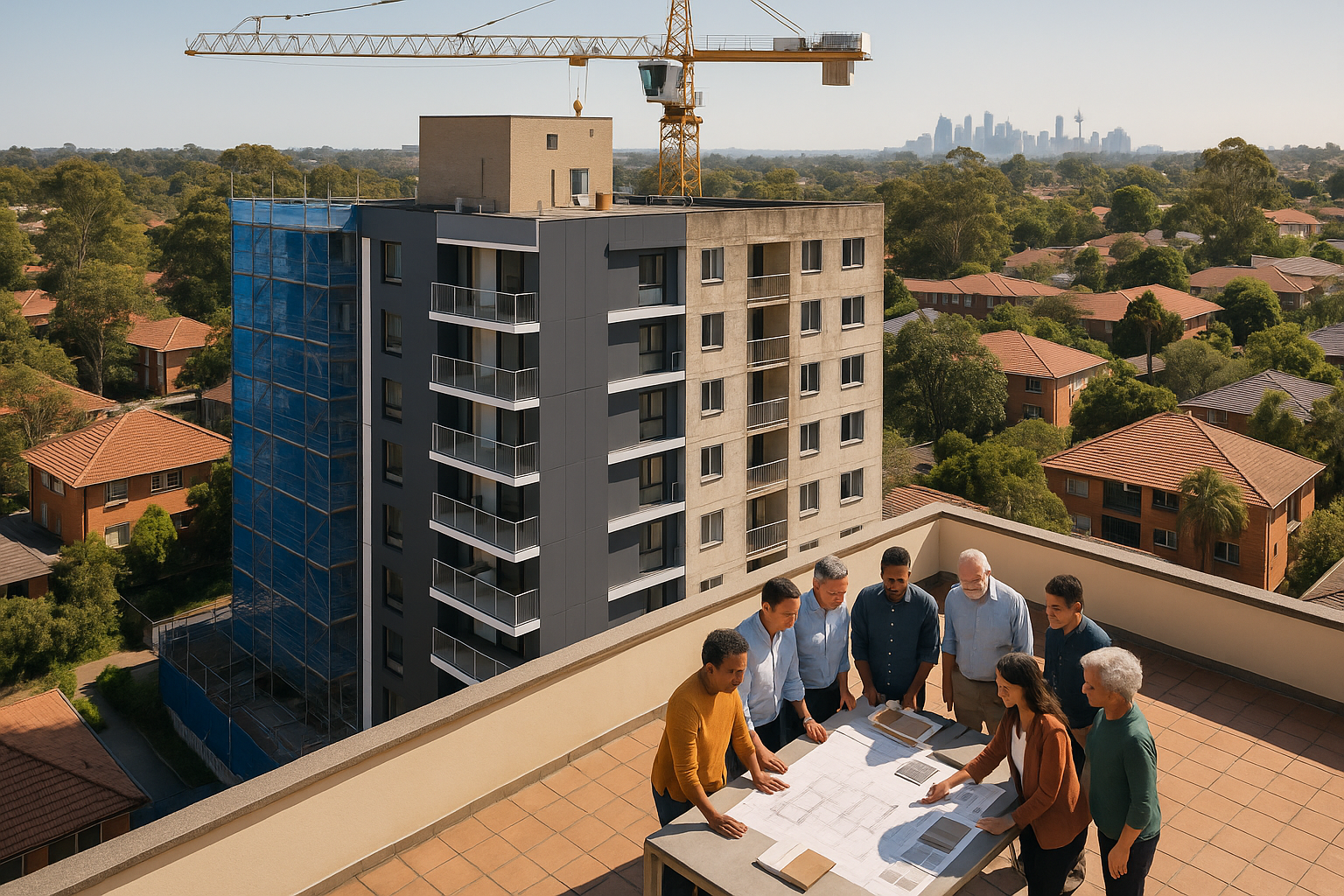
Financing a strata redevelopment or collective sale in NSW usually means choosing between three paths: sell the building “as is” to a developer, borrow as an owners corporation to upgrade or redevelop, or structure a joint venture where the developer funds and delivers new lots. Each option changes levies, values, tax and risk in different ways, so your committee’s job is to put numbers and timelines around those trade‑offs before you vote.
In practice, that means modelling per‑lot cashflows, testing lender appetite, and pressure‑testing whether owners can cope with both construction disruption and higher levies or debts.

1. Start with your strategic choice: sell, renew or partner
1.1 Three broad finance directions
Almost every strata renewal decision sits in one of three buckets:
- Collective sale “as is” – no building‐level borrowing. Owners sell to a developer, then sort their own finance for their next home or investment.
- Owners corporation redevelopment loan – the scheme borrows to fund major works, often combined with uplift (extra floors, new lots) to increase value.
- Developer‑funded uplift / JV – the developer funds construction (airspace, new lots, knockdown‑rebuild), and the scheme shares in the proceeds or receives works in kind.
Your committee must surface: who can afford to stay, who needs a clean exit, and how much risk appetite the scheme has for multi‑year construction and debt.
1.2 Quick comparison: what changes for owners?
| Option | Who carries project debt? | Cashflow impact on owners | Typical profile |
|---|---|---|---|
| Collective sale | Developer (post‑purchase) | Lump‑sum sale proceeds; no levies for works | Older or highly geared owners wanting out |
| OC redevelopment loan | Owners via levies and sinking fund | Higher levies for 5–15 years; potential value uplift | Mixed schemes where majority can afford higher levies |
| Developer‑funded uplift | Developer funds build; owners may fund enabling works | Lower upfront levies but more legal complexity; windfall if well‑negotiated | Well‑located sites with significant uplift potential |
The strategy continues below
You've seen the problem and the groundwork — now unlock the exact steps our CPA-certified brokers use, including 5 more sections. Enter your email for instant, free full access.
Free access. No spam — unsubscribe anytime. Your details stay confidential.
Frequently asked questions
How is a strata redevelopment usually financed in NSW?▾
What is a collective sale and how does it affect my mortgage?▾
Can an owners corporation in NSW borrow for a knockdown‑rebuild?▾
What risks do strata owners face with a developer‑funded renewal?▾
How do higher strata levies from a building loan affect my personal borrowing power?▾
Request a strategy call
Confidential consultation with a triple-qualified advisor — commercial, SMSF, equipment and development finance.