
Article
Self-Employed Home Loan Paperwork: A Practical Step-by-Step Checklist
Self-employed Australians can get home loans without payslips, but the paperwork bar is higher. This step-by-step checklist shows exactly which documents you’ll need, how much history lenders want and what you can pull together this week to be application-ready.
Key Takeaway
Self-employed Australians need more paperwork for home loans, typically including two years of personal tax returns, business financials, BAS or bank statements, plus full details of debts, living expenses and savings. Most lenders also apply a 3% serviceability buffer above the interest rate, so accurate documents are critical for assessment. By following a structured checklist and matching the right documentation pathway, borrowers can improve approval odds and secure sharper pricing on their next home loan.

Self-Employed Home Loan Paperwork: A Practical Step-by-Step Checklist
If you’re self-employed, you absolutely can get a home loan – but the paperwork is different and the bar is higher than for PAYG employees. In practice, most lenders want two years of personal tax returns, business financials, BAS or bank statements, plus full details of your debts, expenses and savings before they’ll approve a loan at sharp rates. This guide walks through exactly what documents you need and the order to pull them together.
Think of this as your decision-grade checklist. By the end, you’ll know which documentation pathway (full-doc or alt-doc) fits you, what’s missing, and what you can get done this week to be application-ready without stalling your business.

1. How lenders look at self-employed paperwork
Before diving into the list, it helps to know what lenders are trying to prove.
- Is your income real, stable and likely to continue?
- Can you afford the loan if rates rise or income dips?
- Are your business and personal finances compliant and under control?
In Australia, most lenders:
- Want at least two full years of personal tax returns and business financials before fully relying on self-employed income. [^1]
- Prefer at least two years of continuous ABN trading as a sign your business is sustainable. [^2]
- Assess your repayments using a 3 percentage point buffer above the actual rate, as guided by APRA expectations. [^3]
Your paperwork needs to tell a clear story that ticks all three boxes.
There are three broad documentation pathways:
- Full-doc – standard, cheapest, based on lodged tax returns and financials.
- Alt-doc (alternative documentation) – for self-employed borrowers using BAS, bank statements and/or accountant letters instead of full financials.
- Low-doc – now niche, higher cost, usually for complex or higher-risk situations.
For a fuller comparison of these pathways, see Choosing the right documentation pathway for your next home loan.
Comparison: paperwork by documentation type
| Pathway | Typical borrower situation | Core income documents | Main pros | Main trade-offs |
|---|---|---|---|---|
| Full-doc | 2+ years lodged tax returns and financials, up to date | 2 years personal tax returns + NOAs; 2 years business financials | Lowest rates, widest lender choice | Needs clean, on-time tax and BAS lodgements |
| Alt-doc | Strong income, but returns not lodged or not reflective | BAS (6–12 months), business bank statements, accountant letter | Can borrow sooner, still with mainstreams | Higher rates, often lower max LVR than full-doc |
| Low-doc | Complex/high-risk, limited evidence | Limited docs, declarations, larger deposit | Niche solution for edge cases | Highest cost, strict LVR caps, limited lenders |
For most self-employed borrowers, the goal is either start in full-doc or use alt-doc as a bridge, then refinance to full-doc once you have two strong tax years.
2. Step 1 – Identity, residency and business basics
These are the straightforward documents every lender needs at the start.
2.1 Personal ID and residency
Have two forms of ID, typically:
- Australian passport, or foreign passport with visa details
- Australian driver licence
- Medicare card
- Birth certificate or citizenship certificate (if needed)
If you’re not an Australian citizen, you’ll also need:
- Visa grant notice or VEVO check
- Evidence of how long you’ve been in Australia and working here
2.2 Business structure and ABN
Lenders need to understand how you earn your money:
- ABN registration (screenprint from ABN Lookup), showing:
- Entity name
- ABN
- Start date (ABN age matters – most lenders prefer 2+ years). [^2]
- ASIC company extract (for companies)
- Partnership agreement (for partnerships)
- Trust deed and any amendments (for trusts)
They’ll check that:
- The ABN matches the tax returns and bank accounts.
- Your trading start date lines up with the income history you’re claiming.
If your ABN is less than two years old, lender options narrow quickly. You may still have paths via select full-doc or alt-doc lenders, but policy gets tighter and the rest of your file needs to be strong.
3. Step 2 – Proving income the full-doc way
If you’re relatively established and up to date with the ATO, full-doc is usually your cheapest path.
3.1 Personal tax returns and ATO Notices of Assessment
Most lenders want:
- Last two years of personal tax returns for each applicant
- Last two years of ATO Notices of Assessment (NOAs)
They use this to:
- Confirm your taxable income from salary, business, trust distributions, investments.
- Check that tax has been assessed and paid (or on a plan).
- See whether your income is stable, growing or falling.
If income is variable, many lenders will:
- Use the lower of the two years, or
- Average the two years, or
- Take the most recent year if it is higher and stable.
Worked example – income trend
- FY22 taxable income: $120,000
- FY23 taxable income: $150,000
Some lenders may average: ($120k + $150k) ÷ 2 = $135,000. Others may use the latest $150k if your industry and bank statements support that it’s sustainable.
If FY23 dropped to $110,000, most will assess you on $110,000, not the higher prior year.
3.2 Business financial statements
For companies, partnerships and trusts, you’ll typically need:
- Last two years of business financial statements:
- Profit and Loss
- Balance Sheet
- Business tax returns for the same period
Lenders look for:
- Consistent or growing net profit
- Reasonable drawings / director loans / dividends
- How much cash the business actually generates after expenses
A specialist broker can also help identify add-backs (e.g. one-off expenses, non-cash depreciation) to legitimately boost your assessable income – see How Banks Read Your Business Financials Before a Home Loan.
3.3 Other income sources
You’ll also need evidence for:
- PAYG income (if you pay yourself a wage):
- Recent payslips and a year-to-date summary, and/or
- Income statement from myGov
- Investment income:
- Rental statements or lease agreements
- Dividend statements
- Managed fund statements
- Centrelink / other income (if used):
- Benefit statements
The more consistent and well-documented your income, the easier it is to get full-doc pricing and lender choice.
4. Step 3 – Alternative-doc options when tax returns don’t tell the full story
Not every self-employed borrower has fresh, clean tax returns ready – especially if you’re growing fast or still finalising with your accountant.
That’s where alt-doc loans come in. They let you verify income using:
- BAS statements
- Business bank statements
- Accountant’s letters, sometimes in combination
These loans usually carry higher interest rates and lower maximum LVRs than full-doc options, and are best treated as interim solutions until you can refinance to full-doc. [^4]
For a deeper dive into alt-doc and low-doc options, see:
- From Self-Employed to Homeowner: Getting a Mortgage Without Payslips
- Choosing the right documentation pathway for your next home loan
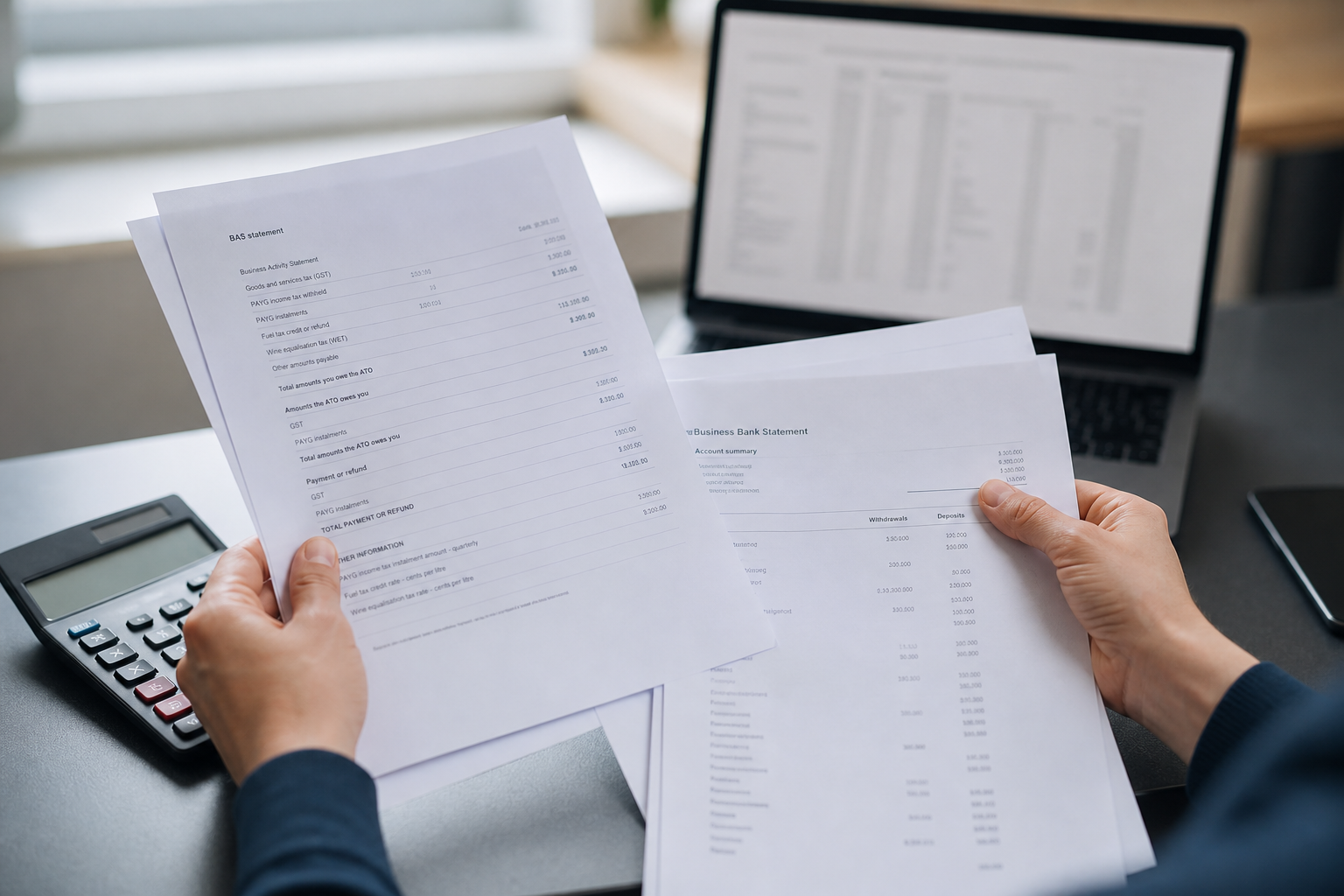
4.1 BAS (Business Activity Statements)
Typical BAS requirements:
- Last 4 quarters of BAS, or
- Last 12 months of BAS if you lodge monthly
Lenders use BAS to:
- Estimate annualised turnover and sometimes profit
- Cross-check that declared income is in the same ballpark
- Confirm you’re lodging on time and managing GST obligations
Late or missing BAS can be a red flag, even if your business is profitable.
4.2 Business and personal bank statements
Alt-doc lenders often ask for:
- 6–12 months of main business transaction accounts
- 3–6 months of personal transaction accounts
They’re looking for:
- Regular inflows that match your claimed income
- No frequent overdrawn balances or dishonours
- Evidence that you can cover both business costs and personal living expenses
4.3 Accountant’s declaration
Some alt-doc products allow an income declaration signed by your accountant. Expect to provide:
- A lender-approved accountant declaration form
- Signed by a registered tax agent or CPA who knows your business
- Stating your estimated sustainable income level
Lenders will still cross-check this against bank statements or BAS. A strong accountant letter can help where your financials are mid-year or temporarily distorted by one-off costs.
5. Step 4 – Debts, expenses and credit conduct
Income is only half the story. Lenders also need to see everything going out the door.
5.1 Personal debts and commitments
You’ll usually be asked for:
- Credit card and overdraft statements (last 3 months)
- Personal loan and car loan statements (last 6–12 months)
- HECS/HELP balance (from myGov)
- Afterpay / Zip / BNPL statements, if significant
Lenders apply repayments to all of these, then add the 3% serviceability buffer on the new home loan. That’s why cleaning up small debts before you apply can materially boost borrowing power.
5.2 Business debts and leases
For self-employed borrowers, business debts often get missed – then surprise you late in the process.
Gather:
- Chattel mortgage / equipment finance contracts and statements
- Business car leases
- Business overdraft / line of credit statements
- Commercial property or business loan statements
Most lenders count these repayments in full in your assessment, even if they’re tax-deductible for the business. The way these are structured can materially affect your borrowing capacity. [^5]
5.3 Living expenses breakdown
You’ll need to complete a detailed monthly living expenses estimate, usually across categories such as:
- Groceries, utilities, phone/internet
- Transport, health, insurance
- School fees / childcare
- Entertainment, holidays, subscriptions
Lenders compare your declared spending to the Household Expenditure Measure (HEM) and take the higher of the two. Bank statements are often reviewed to make sure your figures are reasonable.
6. Step 5 – Deposit, equity and other funds
Next, you need to prove where your deposit and costs are coming from.
6.1 Savings and term deposits
Provide:
- 3–6 months of bank statements for savings accounts
- Term deposit statements
Lenders are checking for:
- Genuine savings (built up over time, not just lump sums)
- Any undisclosed loans or overdrafts
6.2 Gifts and family assistance
If your deposit includes help from family:
- Gift letter in lender format, confirming it’s non-repayable; and/or
- Statutory declaration where required
For loans from family, lenders will usually treat this as a debt, so you’ll need:
- Loan agreement, and
- Statements showing repayment terms
6.3 Equity in existing property / refinance
If you’re refinancing or using equity:
- Current home loan statements (last 6–12 months)
- Rates notice for each property
- Rental statements if the property is leased
Most lenders offer their sharpest rates at ≤80% loan-to-value ratio (LVR), because there’s no Lenders Mortgage Insurance (LMI). [^6] If your equity position gets you under 80%, your options expand significantly.

7. Step 6 – Property and loan details
Finally, lenders need documents about the property and the loan you’re seeking.
7.1 If you’re buying a property
Have ready:
- Contract of Sale (signed by all parties)
- Section 32 / vendor statement (for Victorian properties)
- Deposit receipt
- Details of your solicitor or conveyancer
The lender will then order a valuation. Sometimes they’ll ask for:
- Building and pest reports
- Strata reports (for units/townhouses)
7.2 If you’re refinancing
You’ll need:
- Current home loan statements (last 6–12 months)
- Details of any fixed rates, break costs or discharge fees
- Identification of all borrowers and guarantors
If you’re self-employed and want a better deal without necessarily refinancing, see How Self-Employed Borrowers Can Push Their Bank for a Better Deal – the first step is exactly the same paperwork.
7.3 If buying through a company or trust
On top of everything above, lenders will also need:
- Company constitution
- Trust deed and any variations
- Minutes or resolutions confirming who is borrowing and providing guarantees
They’ll assess both the individuals and the entity, so expect a bit more back-and-forth on structure and serviceability.
8. One-week paperwork action plan for busy self-employed borrowers
If you’re flat out running a business, you don’t have time for a 20-item to-do list. Here’s how to make real progress in seven days.
Day 1–2: Confirm your documentation pathway
- Check: are your last two years’ tax returns and financials lodged?
- If yes, you’re probably a full-doc candidate.
- If not, or if your latest year is unusually low, you may need an alt-doc approach initially.
- Use Choosing the right documentation pathway for your next home loan to sanity-check this.
Day 2–3: Pull the essentials from your files and myGov
- Download personal tax returns and NOAs from your accountant or tax software.
- Log into myGov for HECS details and income summaries.
- Grab ID documents, ABN registration and any ASIC extracts.
Day 3–4: Export bank and loan statements
- From online banking, download CSV or PDF statements for:
- Main business transaction accounts (6–12 months)
- Personal everyday and savings accounts (3–6 months)
- Credit cards, personal loans, car loans (6–12 months)
- If using BAS or alt-doc, also download 12 months of BAS from the ATO portal.
Day 4–5: Get business financials and clarify add-backs
- Ask your accountant for last two years’ business financials and tax returns.
- Highlight any one-off or non-cash expenses that may be add-backs.
- Read How Banks Read Your Business Financials Before a Home Loan so you know what your lender will focus on.
Day 5–6: Map your debts and expenses
- Create a simple list of all personal and business debts, with limits and repayments.
- Draft a monthly living expenses budget by category.
- Check statements for any missed repayments or overdrawn accounts – note anything that needs explaining.
Day 6–7: Sense-check with a specialist broker
- With your documents in one folder, speak to a self-employed focused broker.
- A good broker helps choose the right doc pathway, cleans up inconsistencies and structures the loan so home and business risks are sensibly separated – see Smarter mortgage broking for self‑employed, professionals and owners.
At this point, you should be very close to application-ready – often in under a week if your tax lodgements are up to date.
9. Working with a broker who understands both business and home loans
For self-employed borrowers, paperwork is not just admin – it’s strategy. The same numbers can look strong or weak depending on how they’re presented and which lender and pathway you choose.
A broker who understands both residential lending and business finance can:
- Translate your true earnings into lender language
- Help you sequence tax planning and borrowing so one doesn’t sabotage the other
- Separate home, investment and business debt into clear loan splits so future refinancing stays simple and tax-effective
If you’re a first-home buyer running a small business, pair this article with Buying Your First Home When You Run a Small Business and you’ll have a realistic picture of what’s achievable this year.
FAQs
1. How many years of tax returns do I need for a self-employed home loan?
Most Australian lenders want at least two full years of personal tax returns and business financial statements before they’ll fully rely on self-employed income. A smaller number of lenders may use one year of figures, but usually with tighter policy, lower borrowing capacity or slightly higher pricing. If you only have one year of trading, expect your options to be limited and heavily case-by-case.
2. Can I get a home loan if my latest year’s income dropped?
Yes, but it may reduce how much you can borrow. Many lenders will use the lower of the two most recent years if your income has fallen, on the assumption that this is the more realistic number. Some will consider using a higher figure if you can clearly explain a one-off drop and current bank statements show recovery, but you’ll need stronger supporting paperwork.
3. What if my tax returns aren’t lodged yet?
If you’re behind on tax lodgements, your lender options narrow quickly. Some alt-doc lenders will use BAS, bank statements and accountant letters in place of returns, but this usually comes with higher rates and lower maximum LVRs. In many cases, it’s more powerful to prioritise lodging your returns, even if that means pausing your application for a few weeks.
4. Do lenders look at my business debts for a home loan?
Almost always, yes. Business car leases, equipment finance, overdrafts and business loans are typically counted in full when assessing your home loan serviceability, because they still rely on your business income. The way these debts are structured can materially change your borrowing capacity, so it’s worth reviewing them with both your broker and accountant before you apply.
5. What paperwork is different for first-home buyers who are self-employed?
The core documents are the same – ID, income, debts, expenses and deposit evidence – but first-home buyers may also need more paperwork around grants or government guarantees. For example, you might need eligibility confirmations for schemes like the First Home Guarantee, plus extra forms from your conveyancer. The key difference is usually timing: you want tax returns, BAS and bank statements to be in good shape before you start making offers.
6. Can I apply for a home loan soon after getting an ABN?
It’s possible but difficult. Most lenders prefer at least two years of ABN trading history, and many will not rely on self-employed income if your ABN is very new. If you recently moved from PAYG to self-employed in the same line of work, some lenders will consider your previous PAYG history, but you’ll need very strong supporting documents and realistic borrowing expectations.
Key takeaways
- Most self-employed borrowers need two years of personal tax returns and business financials, plus BAS and bank statements where relevant.
- Your documents must show stable, sustainable income, clean ATO and BAS lodgements, and manageable debts under a 3% serviceability buffer.
- Full-doc loans usually give better rates and higher LVRs than alt-doc, so use alt-doc only when necessary and plan to refinance later.
- Business debts, leases and even BNPL accounts all count in your assessment, so gather statements and tidy them before you apply.
- A one-week focused push can get your paperwork 80–90% complete, especially with help from your accountant and a self-employed focused broker.
If you’d like help turning this checklist into an actual pre-approval, a specialist broker who works with self-employed, professionals and business owners can review your documents, choose the right documentation pathway and structure your loans so they support both your home and business plans.
General advice only.
Frequently asked questions
Talk to a CPA-certified broker
Free consultation, plain-English advice tailored to your situation.