
Article
Rose Bay apartments: financing older Art Deco blocks versus new builds
Thinking about an older Rose Bay apartment or a shiny new build? This guide explains how lenders view each, what can go wrong with valuations and strata, and how to choose a property that your bank – and your future self – will be comfortable with.
Key Takeaway
Financing an older Rose Bay apartment versus a newer build differs mainly in valuation risk, strata quality and lender appetite, not just age. Older Art Deco blocks often benefit from higher land value and stable demand, while newer buildings can face stricter credit policies due to defects, cladding and off‑the‑plan valuation risk, with many lenders using internal building restriction lists. Buyers should align property type with their borrowing profile and run building‑specific finance checks before bidding.
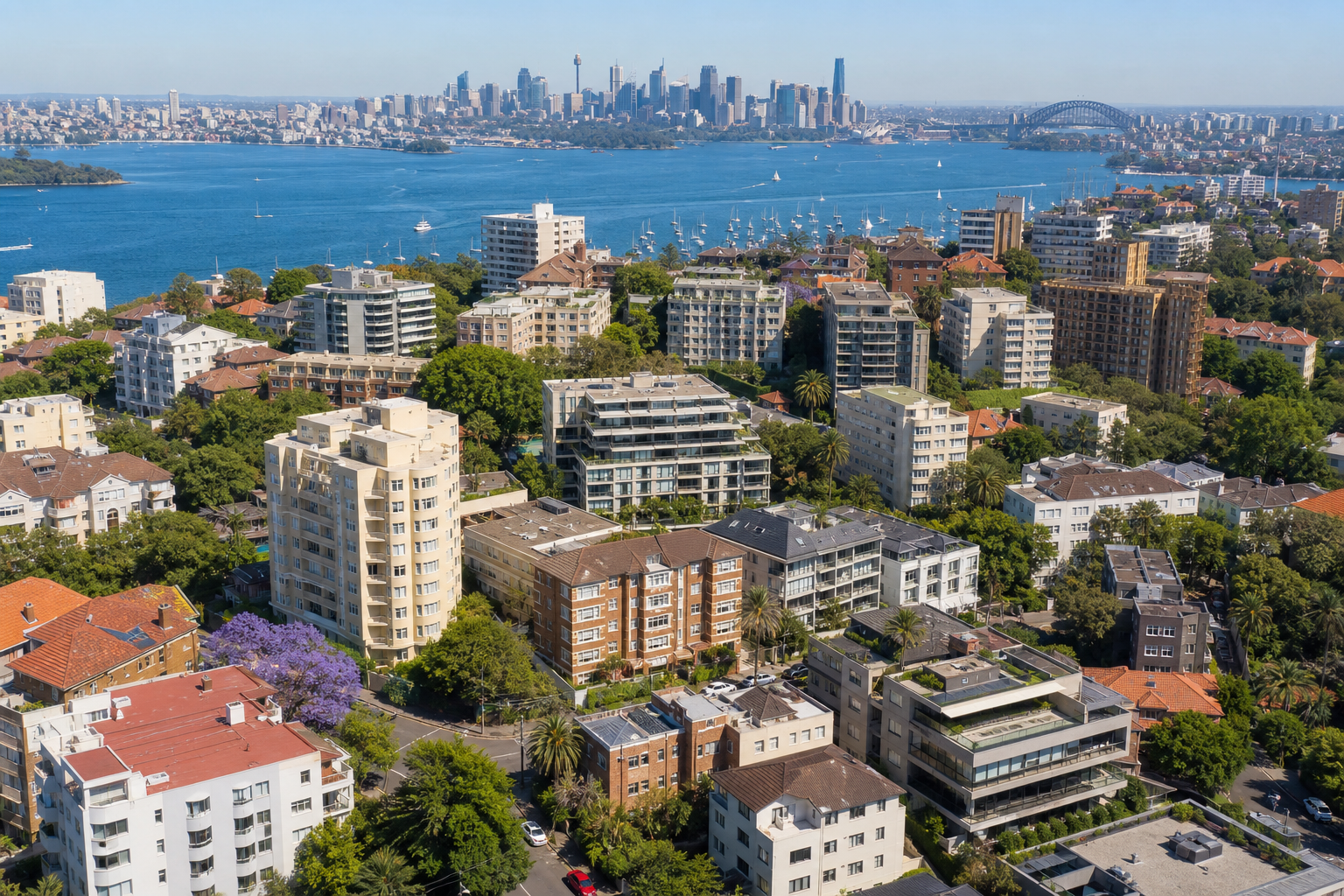
Buying in Rose Bay, one of the biggest finance decisions you’ll make is whether to target an older Art Deco or mid‑century block, or a newer build. Lenders don’t treat these apartments the same. Older blocks can be favoured for land value and resale, while newer buildings can raise red flags about defects, cladding and valuation risk. Understanding these differences now helps you avoid nasty surprises at pre‑approval, valuation or settlement.
This guide unpacks how banks and valuers see each type of Rose Bay apartment, how that flows through to maximum LVRs, deposit size, borrowing capacity and conditions, and what you can do this week to de‑risk your next move.

Older Art Deco blocks and newer buildings in Rose Bay carry different finance profiles.
1. How lenders see Rose Bay’s older blocks versus newer builds
When a bank looks at your loan, they assess two things:
- You as a borrower – income, expenses, debts, credit score, with a 3% APRA serviceability buffer on top of the actual interest rate.
- The property as security – what it’s worth, how easy it is to resell, and any issues that might make it hard to recover their money.
In Rose Bay, the same borrower can get a very different answer depending on whether the property is:
- Older Art Deco / inter‑war (roughly 1920s–1940s)
- Mid‑century / 1960s–1980s walk‑ups
- 1990s–early 2000s low‑rise builds
- Recent builds and off‑the‑plan stock (roughly post‑2005)
Why age and style matter to banks
Age is really a proxy for:
- Construction standards used at the time
- Likelihood of defects or major repairs
- Proportion of land value versus building value
- Strata complexity (lifts, basements, gyms, pools)
- Buyer demand profile (owner‑occupier vs investor‑heavy)
Older Rose Bay blocks often sit on premium land, with fewer units on larger blocks, which valuers tend to like. But they can also carry big-ticket repair risk.
Newer builds feel modern and low‑maintenance day to day, but they attract more lender scrutiny around defects, cladding and how “investor‑grade” the stock looks.
Lenders also maintain internal building‑specific restriction lists for complexes with cladding, structural or mixed‑use issues, and these aren’t visible to the public (a pattern seen across Sydney high‑density areas: see /insights/local-green-square-broker-building-knowledge).
2. Key lending differences at a glance
Here’s how finance often looks when you compare a typical older Rose Bay block with a newer build.
| Factor | Older Rose Bay Art Deco / mid‑century block | Newer Rose Bay build / off‑the‑plan | Likely finance impact |
|---|---|---|---|
| Land vs building value | Higher land component, fewer units per site | Higher building value, more units per site | Older blocks often seen as safer long‑term collateral; newer builds more sensitive to market shifts |
| Valuation risk | Generally stable if well‑maintained | Higher risk of valuation shortfalls, especially off‑the‑plan | May change required deposit or trigger LMI if valuation comes in low |
| Strata complexity | Simpler – no lifts, gyms, big basements | More complex services and common property | Higher running costs; more things that can break and worry lenders |
| Defects & cladding | Age‑related wear, waterproofing, wiring, structure | Modern construction defects, water ingress, cladding, fire issues | Some lenders cap LVR or avoid certain buildings entirely |
| Maximum LVR appetite* | Often up to 80–90% if building is sound | May be reduced in specific complexes or postcodes | Bigger deposit needed if your chosen building is on a restriction list |
| Rental demand | Strong owner‑occupier and downsizer appeal | Attractive to younger renters and investors | Both can rent well; older blocks may see more stable long‑term demand |
*Illustrative only – each lender sets its own policies.
The key message: a good older block can be easier to finance than a marginal new build, and vice versa. You need to judge the specific building, not just the age.

Comparing how lenders assess older versus newer buildings helps you avoid surprises.
3. Older Art Deco and mid‑century blocks: finance pros and cons
3.1 What banks like about older Rose Bay blocks
Many older buildings in Rose Bay sit on blue‑chip streets close to the harbour, with:
- Smaller strata schemes (often 4–12 lots)
- Higher land content per unit
- Solid construction that has already “proven itself” over decades
- Strong owner‑occupier demand, especially from downsizers and professionals
From a finance perspective, this can mean:
- Smoother valuations if recent comparable sales exist
- More comfort on resale – banks can imagine another buyer happily stepping in
- Less concern about developer quality because the building has already stood the test of time
For investors, older stock can also allow value‑add through renovations, which can support the case for future refinancing.
3.2 What can spook a valuer or credit team
The age advantage disappears fast if there are signs of neglect or poor governance. Red flags include:
- Major cracks or movement in common areas or inside units
- Chronic water ingress or waterproofing failures (roof, balconies, bathrooms)
- Old wiring or fire safety non‑compliance
- Timber windows and roofs in obvious disrepair
- Under‑funded sinking fund relative to known upcoming works
- A pattern of repeated special levies over recent years
These issues don’t always stop finance, but they can:
- Trigger a conservative valuation (reducing usable equity or increasing your deposit requirement)
- Lead to lower maximum LVRs from cautious lenders
- Result in loan conditions, such as evidence of upcoming works or insurance coverage
Example: conservative valuation on an older block
- Contract price: $1,600,000 Art Deco two‑bed unit
- Your targeted LVR: 80% (20% deposit)
- You plan for a $1,280,000 loan and $320,000 cash plus costs
If the valuer notes significant upcoming repairs and values the unit at $1,520,000:
- 80% of $1,520,000 = $1,216,000 maximum lend on that valuation
- You now need $384,000 cash plus costs instead of $320,000
The same income, same bank – but the building condition just added $64,000 to your required cash.
3.3 Extra checks for older blocks you can run this week
For any older Rose Bay apartment you’re serious about:
- Order a strata report early – don’t wait until exchange.
- Review 10+ years of AGM and EGM minutes for patterns: water ingress, structural issues, legal disputes.
- Look at the capital works (sinking) fund balance versus likely upcoming costs (roof, windows, common services).
- Walk the building with a critical eye: rooflines, downpipes, cracks, balcony balustrades, fire stairs.
- Ask your broker or solicitor if this block has caused valuation issues in the past.
If you’re aiming to bid at auction, tie these checks into a tighter pre‑approval process. The guide on designing auction‑proof pre‑approval for Rose Bay buyers walks through how to match your finance to the specific building before you raise your paddle.
4. Newer Rose Bay builds and off‑the‑plan stock: finance traps to watch
Newer apartments can be beautifully finished and energy‑efficient, with lifts and secure parking – all great for daily life. But finance risk often shifts from wear and tear to construction quality and market dynamics.
4.1 Developer quality, defects and cladding
Across Sydney, newer buildings have seen high‑profile issues with:
- Waterproofing failures (facades, podiums, bathrooms)
- Structural defects (slabs, beams, foundations)
- Combustible cladding and fire safety non‑compliance
NSW reforms have improved oversight, but lenders still tread carefully.
Many banks now:
- Maintain internal watchlists or blacklists for certain buildings or developers
- Require valuers to specifically confirm there are no known major defects or cladding issues
- Apply lower LVR caps or refuse security in some complexes
You won’t see these lists publicly. This is one of the areas where using a mortgage broker who regularly works in Sydney’s apartment market can materially reduce risk, because they see which buildings and postcodes keep causing problems (/insights/benefits-using-mortgage-broker-australia and /insights/local-green-square-broker-building-knowledge).
4.2 Valuation and LVR issues in newer buildings
Newer apartments can hit valuation hurdles for a few reasons:
- Developer stock or distressed resales pulling comparable prices down
- Many similar units selling at the same time
- Buyers having originally paid a “new build premium” off‑the‑plan in a rising market
For off‑the‑plan contracts, most lenders will lend against the lower of the contract price or final valuation at completion, not whichever is higher (see /insights/off-the-plan-valuation-change-before-settlement). If the valuer comes in under your contract price, your LVR instantly jumps.
Example: new build valuation shortfall
- Off‑the‑plan contract: $1,450,000
- You expect 80% LVR = $1,160,000 loan
- Final valuation at completion: $1,350,000
The lender will generally use $1,350,000:
- 80% of $1,350,000 = $1,080,000 maximum loan
- You must now find an extra $80,000 cash (plus any stamp duty and costs) or accept Lenders Mortgage Insurance and potentially a different lender.
If you’re stretching to buy in Rose Bay, that shortfall can be the difference between settling comfortably and a last‑minute scramble.
4.3 Investor‑heavy and mixed‑use buildings
Lenders also look at who lives in the building:
- Very investor‑heavy complexes can be seen as more volatile in downturns.
- Short‑stay or serviced apartment usage can make some banks walk away entirely.
- Mixed‑use buildings (retail or commercial on the lower levels) can attract lower LVR caps or fewer willing lenders.
Bayside suburbs like Rose Bay are less dense than the CBD, but pockets of newer stock can still be heavily investor‑oriented. Always check:
- By‑laws for any short‑stay or hotel component
- Ground‑floor usage and zoning
- The proportion of lots held by a single owner or developer
If the building is complex, you may need a specialist broker who understands which lenders are comfortable with that style of security (/insights/specialist-vs-generalist-mortgage-brokers).
A broker who understands local buildings can match your situation to the right lender.
5. Strata, renovations and building condition: how they hit your borrowing
Whether the building is 1930s or 2015, strata health is one of the biggest finance drivers that buyers underestimate.
5.1 Special levies and sinking funds
Lenders know that big, unexpected levies can strain cashflow and increase default risk. They’ll pay attention if a valuation or strata report reveals:
- Repeated or very large special levies for core building functions
- A small sinking fund relative to the building’s age and complexity
- Planned major works not matched by a funding plan
As a borrower, you also need to look ahead. A building that just completed a major capital works program and has rebuilt its sinking fund can be safer than one that has deferred everything.
When your broker or bank runs serviceability, they’ll overlay living expenses with a benchmark like HEM plus actual strata levies. If levies are very high, your borrowing capacity may drop.
5.2 Planned lifts, garages and add‑ons
Older Rose Bay blocks without parking or lifts sometimes propose:
- Basement parking excavations
- Lift installations
- Major balcony upgrades
These projects can be fantastic for long‑term value, but they may bring years of levy pressure. Banks don’t automatically say no, but you need to be realistic about cashflow.
If you already run a business or have other loans, think about how those levies combine with repayments. Lenders often treat business loans and equipment finance as ongoing commitments when they assess your home borrowing (see /insights/how-business-equipment-finance-works-australia-plain-english for how this plays out).
5.3 Insurance, bylaws and defects reports
For both old and new buildings, ask for:
- Current strata insurance details – sum insured, exclusions, excesses, flood and storm coverage.
- Any defects reports, engineers’ reports or fire safety audits.
- Confirmation of remediation progress if defects or cladding have been identified.
A clean set of reports can support your broker’s case to a cautious lender. A messy set doesn’t always kill the deal – but it may mean fewer lender options, higher deposits or more reliance on specialist lenders.
6. Different borrower types: which Rose Bay stock fits whom?
Your income pattern, age and plans can make one type of building much easier to finance than the other.
6.1 First‑home buyers and upgrader families
For first‑home buyers or young families, the key constraints are usually deposit size and borrowing capacity.
- A solid older block can be attractive because it tends to hold value well and appeal to future buyers.
- Newer builds can make sense if they offer more space, parking and lift access within your budget.
But if you’re tight on deposit, you want to avoid any building that might:
- Trigger a conservative valuation
- Sit on a lender restriction list
- Require large upcoming levies
Using a fully assessed pre‑approval that’s matched to the type of property you’re targeting is critical in a suburb like Rose Bay; see /insights/rose-bay-auction-home-loan-pre-approval for the process.
6.2 Self‑employed and small‑business owners
Self‑employed borrowers and small‑business owners face two layers of complexity:
- Income evidence – you may be using full‑doc or alt‑doc lending depending on your tax returns, BAS and bank statements (/insights/documentation-pathways-full-doc-alt-doc-low-doc-options).
- Security risk – lenders may already see your income as more variable, so they become more conservative about the property.
In practice, that can mean:
- Lower maximum LVRs offered for the same building compared to a PAYG borrower
- More scrutiny of the building’s history, especially for newer stock
- Higher appetite to finance simple, proven older blocks with strong demand
If your situation is complex, a broker who specialises in self‑employed professionals and small business owners can help map out what’s realistic this week (/insights/mortgage-brokers-self-employed-professionals-small-business-owners).
6.3 Investors and older, asset‑rich borrowers
Investors and borrowers in their 50s and 60s often have:
- Stronger equity but shorter loan terms before retirement
- A focus on rental demand, maintenance and exit strategy
For this group:
- Older blocks with classic features can be ideal long‑term holds, especially if you’re comfortable funding periodic capital works.
- Newer builds with lifts and level access may appeal if you plan to downsize into the unit later, which lenders like as a clear exit strategy (see /insights/borrowing-50s-60s-strong-assets-modest-income).
Either way, your lender will focus on:
- How the loan will be repaid or downsized before or during retirement
- Whether the property will be easy to sell or rent if needed
Choosing a building type you’d happily live in yourself, not just an investor box, tends to support both finance approval and long‑term resilience.
7. Getting finance‑ready for a specific Rose Bay building this week
Once you move from “Rose Bay in general” to a shortlist of actual buildings, your finance prep needs to tighten.
7.1 Tighten your pre‑approval around property type
In the next seven days you can:
- Clarify your target – Older walk‑up? Art Deco? Newer low‑rise with parking? Be specific.
- Ask your broker to stress‑test pre‑approval against that property type: smaller complexes vs bigger schemes, mixed‑use vs pure residential.
- Share addresses or building names for any front‑runners so they can check for obvious lender issues early.
This is the difference between a vague online approval and a genuinely auction‑proof pre‑approval (/insights/rose-bay-auction-home-loan-pre-approval).
7.2 Use local building intelligence
Because lenders maintain building‑specific restriction lists, different banks can offer very different LVRs or say no to the same property.
A good local‑style broker will often know:
- Which strata plans or streets have raised valuation issues before
- Which newer buildings have a history of defects or cladding concerns
- Which lenders are currently comfortable with that style of building
That’s the same principle that makes a truly local broker valuable in high‑density areas like Green Square (/insights/local-green-square-broker-building-knowledge) and it applies in bayside pockets like Rose Bay too.
7.3 Decide if you need a specialist broker
Around 70% of new Australian home loans are now written through mortgage brokers (/insights/benefits-using-mortgage-broker-australia), largely because lender credit policies and building rules have grown more complex.
You may be fine with a high‑quality generalist broker if you are:
- PAYG with stable income
- Buying a straightforward, well‑maintained block with clean strata
You probably need a more specialist broker if you:
- Are self‑employed, juggling business debt and complex tax returns
- Are considering a newer or mixed‑use building with possible defects or cladding questions
- Are borrowing later in life and relying heavily on assets and exit strategy
The article on specialist vs generalist mortgage brokers gives a simple checklist to decide which camp you fall into.
FAQs: Rose Bay older blocks vs newer builds and finance
1. Is it easier to get a loan for an older Rose Bay unit than a new one?
It depends on the specific building. A well‑maintained older Art Deco or mid‑century block with a solid sinking fund and strong demand can be easier to finance than a newer building with defects or cladding issues. But a neglected older block with major structural concerns can cause more headaches than a clean, well‑run modern complex.
2. Do banks lend less against newer apartments because of cladding and defects?
Some do, for specific buildings. Many lenders keep internal restriction lists where they cap LVRs, require bigger deposits, or decline security in complexes with known cladding or defect issues. This isn’t universal across all new stock, but it’s common enough that you should have your broker check any newer Rose Bay building carefully before you commit.
3. How do strata levies affect how much I can borrow?
Strata levies feed into your living expenses when a lender tests serviceability. High ongoing levies, or a history of large special levies, can reduce your assessed borrowing capacity. They can also make a credit assessor nervous if they feel your budget will be tight once levies, mortgage, and other debts are all factored in.
4. I’m self‑employed. Should I avoid newer Rose Bay builds?
Not automatically, but you need to be more selective. Self‑employed borrowers are already seen as higher‑variance income, so adding a risky or complex building can push some lenders over their comfort line. A robust, smaller older block or a simple, defect‑free newer low‑rise may be easier to finance than a large mixed‑use or investor‑heavy complex.
5. What’s the biggest mistake buyers make with newer buildings in Rose Bay?
Relying on a generic pre‑approval and assuming any new building will be fine with the bank. The combination of valuation risk, potential defects and building‑specific lender restrictions means you should run building‑level checks, review strata records and have your broker test that specific complex with likely lenders before you go unconditional or bid at auction.
6. How can I quickly reduce finance risk if I want to buy this month?
In the next week, narrow your target building types, get a fully assessed pre‑approval, and have your broker review recent strata reports and comparable sales for any serious contenders. Focus on buildings with strong demand, healthy sinking funds and no major defect history, and avoid anything your broker flags as repeatedly problematic with valuers or credit teams.
Key takeaways
- Lenders judge Rose Bay apartments on both your income and the building’s risk profile; older isn’t automatically riskier, and newer isn’t automatically safer.
- Well‑maintained older Art Deco and mid‑century blocks with strong land value can attract solid valuations and mainstream lending if strata health is good.
- Newer buildings introduce more valuation, defect and cladding risk, and some complexes sit on lender restriction lists that reduce maximum LVRs.
- Strata reports, sinking funds and upcoming works can materially change both your borrowing capacity and your true out‑of‑pocket costs.
- Your income type and life stage matter: self‑employed and later‑life borrowers benefit most from matching building type to lender appetite and using a specialist broker.
If you’re weighing up an older Rose Bay block versus a newer build, the most practical next step is to line up your pre‑approval with a broker who can sanity‑check specific buildings, review strata and valuation risks, and map out what’s realistically achievable in the next 30–90 days.
General advice only.
Frequently asked questions
Talk to a CPA-certified broker
Free consultation, plain-English advice tailored to your situation.
