Ding Financial logo

Article

Your practical guide to equipment finance eligibility in Australia

A plain‑English guide to how equipment finance works in Australia, what lenders look for, and the concrete steps small businesses can take this week to get approval‑ready.

Published 9 May 2026Updated 9 May 202613 min read
Your practical guide to equipment finance eligibility in Australia

Your practical guide to equipment finance eligibility in Australia

Equipment finance is one of the most useful tools for Australian small businesses, but most owners only discover it when a dealer pushes finance at the last minute. That’s the worst time to be thinking about structure, eligibility and how it affects your bigger goals like buying a home or investment property.

This guide walks through equipment finance basics, what lenders actually look at, and the steps you can take this week to lift your chances of approval and better terms.

In Australia, most lenders will approve equipment finance where:

  • your business has a clear purpose for the asset and a reasonable trading history;
  • projected cashflow can comfortably cover repayments; and
  • the asset is standard, re‑saleable and sensibly priced.

If your financials are messy or you’re newer in business, there are still options—but you need to be more deliberate about structure and documentation.
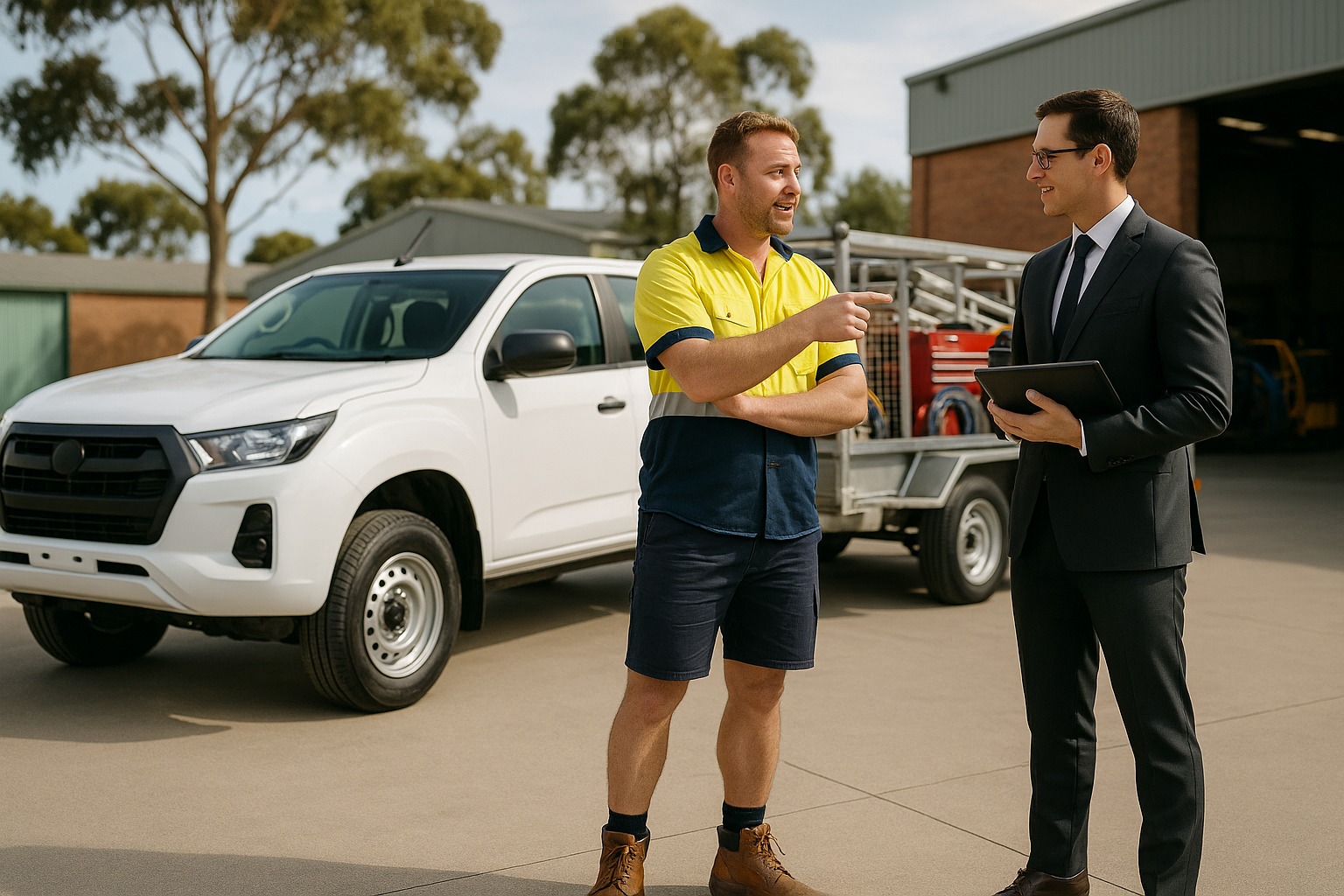
Tradie discussing finance options for new work vehicle and tools Matching your equipment purchase and finance to your business cashflow is critical.


1. Equipment finance in plain English

1.1 What is equipment finance?

Equipment finance is a loan or lease used to buy income‑producing assets for your business—vehicles, machinery, technology, medical equipment, fit‑outs and more. The lender usually takes security over the asset itself instead of your home.

Instead of paying $150,000 upfront for a truck or machine, you might:

  • borrow 80–110% of the purchase price (including GST in some cases);
  • repay it over 3–7 years; and
  • match repayments to the income the asset generates.

Unlike a personal loan or credit card, equipment finance is designed around the asset’s working life and business use.

1.2 Common types of equipment you can finance

Most lenders are comfortable funding standard business gear, including:

  • Vehicles: utes, vans, trucks, trailers, some yellow goods (excavators, skid steers).
  • Plant and machinery: manufacturing lines, CNC machines, forklifts, agricultural machinery.
  • Technology: servers, laptops, point‑of‑sale systems, phone systems.
  • Medical and professional equipment: dental chairs, diagnostic equipment, printing presses.
  • Fit‑outs: shop, office or hospitality fit‑outs where items can be clearly itemised.

The more specialised, custom or hard‑to‑resell the asset is, the more the lender will lean on your business strength and your contribution (deposit or additional security).

1.3 How equipment finance differs from overdrafts and term loans

You can fund equipment with a general business loan or overdraft, but it’s usually not ideal.

Key differences:

  • Security: Equipment finance is usually secured by the asset; overdrafts often use property or directors’ guarantees.
  • Rate: Because the loan is tied to a hard asset, rates are often sharper than unsecured business loans (exact rates vary and are always indicative only).
  • Term: The term is matched to the asset’s life (say 3–7 years), which keeps repayments predictable. Overdrafts are technically repayable on demand.
  • Tax and accounting: Different structures (chattel mortgage vs lease) have different GST and deduction rules. Your accountant should guide this.

If vehicles are your main need, it’s worth reading our dedicated guide on smart vehicle finance options for tradies and small businesses alongside this article.


2. How lenders assess equipment finance applications

Regardless of the lender or structure, most equipment finance approvals come down to five pillars.

2.1 Pillar 1 – Your business story

Lenders want to understand:

  • What your business does and how the new asset helps you make money or reduce costs.
  • How long you’ve traded: 2+ years is ideal, but some lenders will consider well‑documented start‑ups.
  • Who runs it: your experience in the industry and track record.

A clear one‑page summary of your business, with simple numbers and no jargon, can do more than a thick business plan nobody reads.

2.2 Pillar 2 – The asset itself

The asset is the lender’s primary security, so they care about:

  • Type and condition: new is easier than second‑hand; mainstream brands are easier than niche imports.
  • Useful life vs loan term: a 7‑year term on equipment that will be scrap in 4 years is a red flag.
  • Price: they’ll compare the invoice to market values to make sure you’re not overpaying.

If you’re buying used gear, expect the lender to cap the age and the combined age + term (e.g. vehicle not older than 12 years at the end of the loan).

2.3 Pillar 3 – Serviceability (can you afford it?)

Serviceability is simply your ability to meet repayments with a buffer.

A lender might look at your last two years’ financials and year‑to‑date performance, then ask:

  • After normal business expenses and owners’ drawings, is there enough surplus to cover the new repayment?
  • What happens if interest rates rise or income dips temporarily?
  • Are you already stretched servicing other loans and credit cards?

Example:
You run a plumbing business with $450,000 revenue and $320,000 expenses. Your net profit before tax and your wage is $130,000. You want a $70,000 ute over 5 years at an indicative 9% p.a.

Approximate monthly repayment: about $1,455.

If your household living costs and other debts are under control, a lender will often view this as manageable—because the ute helps generate income and the repayment is a modest slice of your profit.

2.4 Pillar 4 – Equity and security

Lenders are more comfortable when you have skin in the game:

  • A deposit (say 10–20%) or a trade‑in.
  • Strong retained profits in the business.
  • In some cases, additional security (e.g. second charge over another business asset).

For stronger businesses and mainstream assets, many lenders will fund up to 100% of the purchase price, sometimes plus soft costs (stamp duty, accessories). For newer businesses or weaker assets, expect to contribute more.

2.5 Pillar 5 – Credit history and conduct

Two things matter here:

  • Credit reports: defaults, judgments, too many recent enquiries.
  • Account conduct: late payments on existing loans, overlimit credit cards, dishonoured business debits.

A single old phone default isn’t necessarily fatal, but a pattern of missed repayments is. If you know there are blemishes, front‑foot them with an explanation and show that the behaviour has changed.


3. Basic eligibility: can my business qualify today?

3.1 Typical baseline criteria

Every lender is different, but a mainstream equipment lender will often want to see:

  • An ABN registered for 1–2 years or more.
  • GST registration if your turnover is above the threshold.
  • At least one year of financial statements or tax returns, plus current BAS or management accounts.
  • Clear identification for all directors / proprietors.

Start‑ups can sometimes obtain equipment finance where there is strong industry experience, a job‑to‑go (e.g. contract in hand) and a decent deposit. But the fewer runs on the board you have, the more conservative you should be.

3.2 Income proof: full‑doc vs low‑doc options

For well‑established businesses, full‑doc lending (tax returns, financial statements and BAS) generally gets better pricing and more flexibility.

Where your books are behind or income is more volatile, some lenders offer low‑doc or alt‑doc options using:

  • BAS statements;
  • business bank statements;
  • accountant declarations; or
  • management accounts.

This mirrors the trade‑offs we explore for mortgages in our guide on getting a home loan without payslips as a self‑employed borrower: less documentation can mean higher rates or lower maximum amounts.

3.3 Deposits, balloons and residuals

  • A deposit reduces the amount financed and can help borderline applications.
  • A balloon (for chattel mortgages) or residual (for leases) pushes part of the cost to the end of the term, lowering monthly repayments.

Example:
Equipment price: $100,000 (ex GST).
Option A: 0% deposit, no balloon, 5 years at an indicative 9% p.a. → approx. $2,076/month.
Option B: 20% deposit ($20,000) and 20% balloon ($20,000) → approx. $1,253/month.

Total interest is higher in Option B, but the repayment is easier on cashflow. Your accountant should help decide the right balance between cash, tax and borrowing costs.

3.4 When your profile is more complex

You might still be finance‑able if:

  • You’re in year 1–2 of a new business but have strong industry experience.
  • You’ve had a rough year but can show recovery in year‑to‑date figures.
  • You have past credit issues that are now well behind you.

In these cases, structure really matters. For example, pairing smaller, shorter‑term finance with a realistic balloon, or staging purchases instead of doing everything at once.

Our broader guide on moving from start‑up grind to homeowner in five years has useful tips on cleaning up your numbers that also apply to business lending.


4. Common equipment finance structures and their eligibility quirks

You don’t need to become an accountant, but knowing the basic differences helps you ask better questions.

Diagram comparing common equipment finance structures for small business The right finance structure depends on tax treatment, ownership and cashflow priorities.

4.1 High‑level comparison

The tax points below are general only. Always check specifics with your accountant.

StructureWho owns the asset during term?Typical termGST timing (general)Common usesEligibility quirks
Chattel mortgageYou/your business3–7 yearsClaim GST upfront on purchaseVehicles, standard plant & equipmentNeeds balance sheet capacity for debt
Finance leaseLender then you (via residual)3–5 yearsGST on rentals over timeVehicles, tech, equipment with upgrade cyclesOften requires stronger financials
Hire purchaseLender until final payment3–5 yearsSimilar to chattel in effectVehicles, machineryLess common but similar assessment
Rental/operating leaseLender2–5 yearsGST on each rental paymentIT, short‑life assetsUsually shorter terms, lower residuals

Your accountant will usually steer you toward one or two options that align with your tax and accounting strategy. A good broker can then match that to lenders that like your industry and asset type.

4.2 Chattel mortgage

This is the workhorse structure for many small businesses.

  • You own the asset from day one.
  • The lender takes a mortgage (charge) over it until the loan is repaid.
  • You can often claim GST on the purchase upfront if registered.

Eligibility is mainly about serviceability, asset quality and your credit file. Many lenders have streamlined scorecard approvals for chattel mortgages on standard vehicles and equipment.

For vehicles specifically, see how chattel mortgages compare in our guide on smart vehicle finance for tradies and small businesses.

4.3 Finance lease and operating lease

With a lease:

  • The lender owns the asset during the term.
  • You pay regular rentals for the right to use it.
  • There is usually a residual value at the end (for a finance lease) or options to extend/return/upgrade (for operating leases).

Because ownership and residual risk sit with the lender, they often look more closely at your financials and how critical the asset is to your operations.

4.4 Hire purchase and rentals

Hire purchase and rentals sit somewhere between a chattel mortgage and a lease. They’re less about semantics and more about your accountant’s preferred treatment.

From an eligibility perspective, lenders still care about:

  • Your trading history.
  • The asset quality and resale value.
  • Whether the term and residual are realistic.

5. Documentation: what you’ll usually be asked for

There’s a separate deep‑dive in this cluster on the documentation and application process for equipment loans, but here are the basics so you can prepare.

5.1 For the business

  • ABN and, if relevant, ACN.
  • Company, trust or partnership documents.
  • Last 1–2 years of financial statements and tax returns.
  • Latest BAS statements (often last 2–4 quarters).
  • Year‑to‑date management accounts for larger deals.

For smaller, simpler vehicle and equipment deals, some lenders offer “no‑financials” scorecard approvals up to certain limits where they rely mainly on bank statements, credit checks and your ABN history.

5.2 For the owners/directors

  • Driver’s licence and secondary ID.
  • Personal tax returns for smaller businesses or where income is closely tied to the owner.
  • Details of existing personal loans, credit cards and mortgages.

If you’re also planning to buy a home or refinance in the next 1–2 years, coordinate the timing of major equipment purchases with your mortgage strategy. Our savvy refinancer’s playbook explains how extra debts can affect your overall borrowing power.

5.3 For the asset

  • Supplier quote or formal tax invoice.
  • Spec sheets, model details, serial numbers.
  • Photos and independent valuation for certain second‑hand or specialised assets.

Being organised here speeds up approval and gives lenders confidence you’re in control of the purchase.


6. Worked approval scenarios

6.1 Scenario A: Established electrician upgrading vehicles

  • Business: 6‑year‑old electrical contracting company.
  • Turnover: $850,000; net profit before tax and owner’s wage: $220,000.
  • Proposal: Two new vans at $55,000 each (incl. GST) under chattel mortgages over 5 years.
  • Other debts: modest home loan, one existing ute loan expiring in 12 months.

Indicative repayments: about $1,100 per van per month = $2,200 total.

With clean financials, GST registration, and a good credit record, this is the kind of profile that often qualifies for 100% funding, relatively sharp rates and fast approval—especially for mainstream vehicles.

6.2 Scenario B: New café fitting out premises

  • Business: new café, owners have strong hospitality backgrounds.
  • Proposal: $180,000 for kitchen equipment and fit‑out on a mix of rental/lease facilities.
  • Trading history: 4 months.
  • Security: $50,000 cash contribution, remaining savings, and personal guarantees.

This is higher risk for lenders: limited trading history and a lot of custom fit‑out that’s hard to resell.

Approval is more likely where:

  • The café is in a strong location with a commercial lease in place.
  • There’s a detailed equipment list with realistic prices.
  • The owners can show personal savings and a clear household budget.

Expect more questions, and potentially a staged approach: financing the core kitchen kit first, then considering front‑of‑house equipment once trading is proven.

6.3 Scenario C: Tradie with past credit issues

  • Business: sole‑trader carpenter, 3 years ABN.
  • Proposal: $45,000 ute, 5‑year chattel mortgage.
  • Issue: two small paid defaults from 3 years ago; clean conduct since.

A mainstream bank may decline on policy. Specialist asset finance lenders may still consider it at a higher rate, especially if:

  • Defaults are paid and explained (e.g. relationship breakdown, period of illness).
  • Bank statements show stable income and good conduct over the last 6–12 months.
  • There’s at least a small deposit or trade‑in.

This is where a broker who understands both consumer and business lending rules can help balance your short‑term needs with long‑term goals like getting a mortgage.

Café owner reviewing equipment finance eligibility checklist Even newer businesses can access equipment finance with a clear plan and tidy numbers.


7. One‑week action plan to improve your eligibility

You don’t need months to become more “bankable”. A focused week can make a real difference.

7.1 Day 1–2: Get clear on the asset and numbers

  • Nail down what you actually need, not what the salesperson wants to sell you.
  • Get written quotes from suppliers, with itemised costs.
  • Draft a simple cashflow impact: how much extra revenue or savings the asset should generate vs the expected repayment.

7.2 Day 3–4: Clean up your financial story

  • Reconcile your accounting file and ensure BAS is up to date.
  • Pay or arrange terms for any overdue ATO amounts where possible.
  • Check your personal and business bank accounts for recurring dishonours or overdrawn patterns—and fix the behaviour now.

Many of the same habits that help you qualify for a home—clean statements, predictable drawings, controlled personal spending—are exactly what business lenders like to see.

7.3 Day 5–6: Tidy your credit and documentation

  • Order a copy of your credit report and note any errors or old defaults.
  • Gather IDs, tax returns, BAS, and key contracts you can use to support income.
  • Prepare a one‑page summary explaining your business, the asset, and how it will be used.

7.4 Day 7: Sanity‑check structure and timing

  • Talk to your accountant about the best finance structure (chattel vs lease vs rental) for tax and accounting.
  • Talk to an independent broker about which lenders suit your profile and how this might impact other goals (like buying a home or commercial premises later).
  • Decide whether to wait and strengthen your position or proceed now with a realistic understanding of likely terms.

If you’re considering owning your business premises down the track—either personally or via an SMSF—the choices you make now on equipment and vehicle finance will feed into that bigger strategy. Our guide on whether your SMSF should own your business premises is a useful long‑term reference.


Key takeaways

  • Equipment finance lets you spread the cost of income‑producing assets over their working life instead of draining cash upfront.
  • Eligibility hinges on your business story, the quality and resale value of the asset, your ability to service repayments, and your credit conduct.
  • Stronger, established businesses can often secure up to 100% funding on standard vehicles and equipment; newer or higher‑risk profiles may need deposits or staged purchases.
  • The choice between chattel mortgage, lease, hire purchase or rental has tax and cashflow impacts—get your accountant and broker on the same page early.
  • A focused week tidying your financials, credit behaviour and documentation can materially improve your approval odds and the terms you’re offered.

If you’d like help pressure‑testing your plans, a broker who understands both business and personal lending can map out how equipment finance today affects your borrowing power for homes or commercial property tomorrow—and structure things so they work together, not against each other.

General advice only.

Frequently asked questions

Most lenders will finance income‑producing assets such as vehicles, trucks, plant and machinery, IT and office equipment, medical gear and some fit‑outs. The more standard and re‑saleable the item, the easier it is to finance. Highly specialised or custom gear may still be financeable but usually requires stronger business financials or a higher deposit.

Talk to a CPA-certified broker

Free consultation, plain-English advice tailored to your situation.

Your details are kept confidential. We’ll never share them.